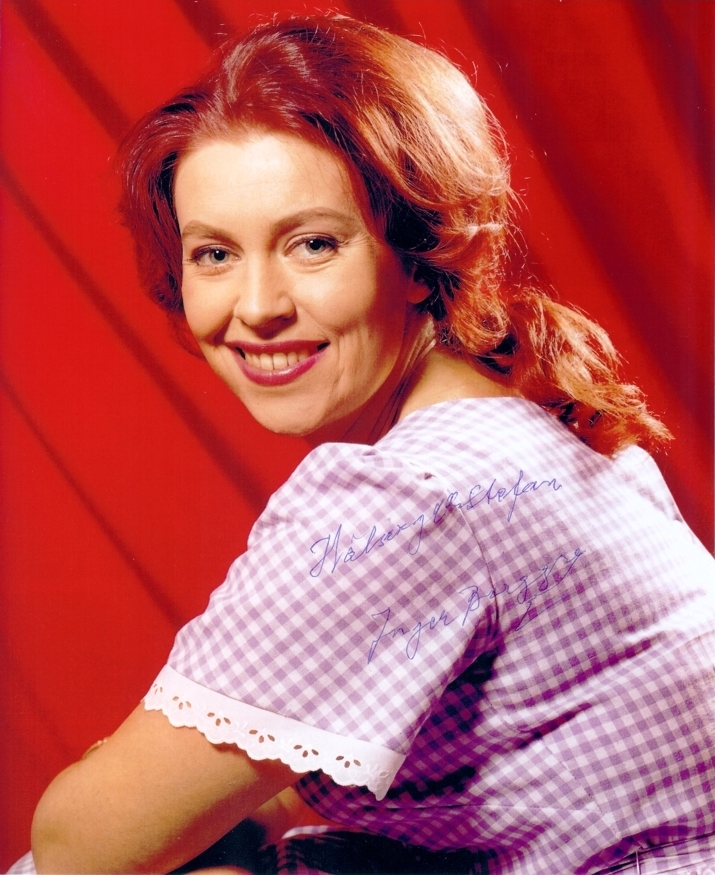
The Swedish national final, called Eurovisionsschlagern - Svensk final, was held on February 13th in Stockholm, hosted by Bengt Feldreich. Each of the songs was performed twice (firstly with a big orchestra, then with a small orchestra), and the winner was chosen by postcard voting. The winning song, Sol och vår, was written and composed by Ulf Källkvist and Åke Gerhard. Lilly Berglund and Inger Berggren both sang Sol och vår but Inger was chosen by the public as the winner.
Results:
1. Sol och vår - Inger Berggren/Lilly Berglund, 102327 votes
2. När min vän - Monica Zetterlund/Carli Tornehave, 74077 votes
3. Anne-Li - Carli Tornehave/Otto Brandenburg, 13401 votes
4. Lolo-Lolita - Otto Brandenburg/Östen Warnerbring, 11848 votes
5. Sagans underbara värld - Lilly Berglund/Inger Berggren, 6885 votes
6. Trollen ska trivas - Östen Warnerbring/Mona Grain, 4001 votes
***
Inger Berggren (born February 23 1934 in Stockholm) is a Swedish singer and actress who began singing in Thore Swanerud's orchestra, and later sang with Thore Ehrling, Simon Brehm, and Göte Wilhelmsson. Her biggest hits were The Sun and the Spring and Elisabeth Serenade, both in 1962. She is mother to the actress Gunilla Röör.
Inger Berggren represented Sweden in the Eurovision Song Contest 1962 in Luxembourg with the song Sol och vår which was placed 7th.
Sweden chose their entrant for the Eurovision Song Contest 1961 through Melodifestivalen 1961. The Swedish national final was held on February 6th at Cirkus in Stockholm, hosted by Jeanette von Heidenstam.
Each of the songs was performed twice (firstly with a big orchestra, then with a small orchestra). The winner was chosen by the votes of 4 juries. Approximately 550 songs were submitted to SVT for the competition. The final was broadcast on Sveriges Radio TV, but was not broadcast on radio.The song April, April, performed once with Siw Malmkvist, once with Gunnar Wiklund, won. Although Siw Malmkvist won the final, she was not chosen to go forward to the ESC, mainly due to the fact that she couldn't stop laughing during her performance of April April, so she was replaced by Lill-Babs. In the contest, once more held in Cannes, she finished in 14th place.
Results:
1. April April - Siw Malmkvist/Gunnar Wiklund, 78 points
2. Vårvinter - Lill Babs/Lars Lönndahl, 71 points
2. Spela på regnbågen - Lars Lönndahl/Lilly Berglund, 71 points
4. Vår i hjärtat - Gunnar Wiklund/Siw Malmkvist, 58 points
5. Stockholm - Lilly Berglund/Lill Babs, 57 points
***
Lill-Babs (born Barbro Margareta Svensson on 9 March 1938 in Järvsö, Gävleborg County) is a Swedish singer and actress.
At the age of fifteen, she sang on the radioshow Morgonkvisten. The Swedish band leader and talent scout Simon Brehm contacted her and invited her to audition in his studio in Stockholm. The audition went well, and she moved to Stockholm to begin her career in show business.
In 1954, just as her fame was beginning to grow, the unmarried Lill-Babs became pregnant - a potential public scandal in Sweden of the mid-1950s. After giving birth to her daughter, Lill-Babs returned to focus on her career. However, Simon Brehm had by then found a new vocalist to take her place, Lill-Babs received an offer to tour with Kettil Olsson. A couple of years later she started to work again for Simon Brehm and went on to perform many concerts at dance palace Bal Palais and other tours.
In 1958, she went on her first self-produced tour and was cast in a movie. She released many records, which became big sellers, Svensktoppen entries and schlager standards in Sweden. A couple of songs were composed by the then relatively unknown Stig Anderson. He would go on to write several of Lill-Babs' hits in the 1960s and in the early 1970s.
During this time Lill-Babs did much of her work in West Germany, where many of her records, television shows, and movies were produced. As a result of this she became a big star in Germany, considered as popular as TV-artist Caterina Valente.
In 1960 Lill-Babs participated at Melodifestivalen with the song En Kyss, En Kyss which didn't reach the final. In 1961 she represented Sweden in the Eurovision Song Contest with April April in Cannes where she came 10th. In 1969 she took part in the Norwegian national final for the ESC with the song Juksemaker Pipilort which came 10th. In 1973 Lill-Babs participated again at Melodifestivalen with the song Avsked Från En Vän which came 4th.
Lill-Babs' 1971 Svensktoppen hit Välkommen Till Världen, originally composed as a contender for Melodifestivalen of that year, was written and produced by Björn Ulvaeus and Benny Andersson and it is also one of the earliest recordings to feature backing vocals by all four future members of the band.
In 1974, Lill-Babs played the lead in the Swedish cast of musical Annie Get Your Gun. She received excellent reviews overall and was after twenty years in show business finally acknowledged for her talent as an allround entertainer, singing, acting and dancing. In the following three decades she would go on to play sold-out cabarets at venues like Berns Salonger and Hamburger Börs in Stockholm, often with material written especially for her by renowned Swedish writers such as poet Lars Forssell and singer and lyricist Barbro Hörberg.
At the age of 74 Lill-Babs is still going strong and still frequently touring Sweden.
Sweden chose its entry for Eurovision Song Contest 1960 by the national final, Melodifestivalen 1960. The winning song, Alla andra får varann was performed once by Östen Warnerbring and once by Ingrid Berggren. However Sveriges Radio decided that Siw Malmkvist would represent Sweden, as she had been denied that the previous year.
Melodifestivalen 1960 was the selection for the third song to represent Sweden at the Eurovision Song Contest. It was the second time that this system of picking a song had been used. It was held on February 2 1960 at Cirkus in Stockholm. A semi-final had been held to select the 4 finalists on December 28 1959. Approximately 1100 songs were submitted to SVT for the competition. The final was broadcast on Sveriges Radio TV and Sveriges Radio P1 from Cirkus, Stockholm and the presenter was Jeannette von Heidenstam. Last year's winner Siw Malmkvist was selected to sing the winning son, Alla andra får varann, at Eurovision.
At the final of Melodifestivalen two artists sang the same song, one with a large orchestra and a second with a smaller orchestra.
Results:
1. Alla andra får varann - Östen Warnebring/Inger Berggren, 85 points
2. Underbar, så underbar - Inger Berggren/Östen Warnebring, 76 points
3. Alexander - Mona Grain/Britt Damberg, 67 points
4. Nancy, Nancy - Britt Damberg/Mona Grain, 56 points
***
Siw "Siwan" Gunnel Margareta Malmkvist (born December 31 1936 in Landskrona, Skåne County, Sweden) is a Swedish singer who is popular in Scandinavia and Germany. She had a number one hit in West Germany in 1964 with Liebeskummer lohnt sich nicht and on 18 July 1964, a full decade before ABBA, she historically had also become the first Swede to have a hit on the US Billboard chart with Sole Sole Sole, a duet with Italian singer Umberto Marcato.
Siw Malmkvist is a performer with great versatility in the Swedish entertainment business as she, alongside her career in pop/schlager music, has performed in stage plays, musicals and in films. She played Pippi Longstocking in the popular children musical production of Astrid Lindgren's Pippi Longstocking in 1980, appeared in the musical version of Some Like It Hot and she played the part of Luisa in the original Swedish - and European - production of Maury Yeston's musical Nine in 1983. In 2002 she appeared as the Mother in Hasse Alfredson's stage play Lille Ronny at Maximteatern. With actor Thorsten Flinck she made a popular Swedish cover of Nick Cave/Kylie Minogue's 1995 hit Where the Wild Roses Grow.
In 2008/2009, she played the part of Fräulein Schneider in the musical Cabaret at Stockholms Stadsteater directed by Colin Nutley.
Having had some 40 hits on Swedish radio chart Svensktoppen and 20 on the German singles chart, Siw has altogether recorded about 600 songs (and has made recordings in ten different languages: Swedish, Danish, Norwegian, Finnish, Dutch, German, English, French, Italian and Spanish) throughout the past five decades, which makes her one of the most productive and successful Swedish female singers.
Siw Malmkvist has been a contestant in the Swedish Melodifestivalen several times, most recently in 2004 together with Towa Carson and Ann-Louise Hanson, singing the song C'est la vie, which finished 10th. She represented Sweden at the Eurovision Song Contest 1960 in London with Alla andra får varann which came 10th. In turn, the following year Malmkvist, who famously forgot the lyrics to the song during her performance, and Gunnar Wiklund both won Melodifestivalen with the song April, april, but then Sveriges Radio selected Barbro "Lill-Babs" Svensson as the Swedish representative at the international Contest, held in Cannes. In 1969 Malmkvist again returned to Eurovision, but then performing the West German entry "Primaballerina" at Madrid, incidentally finishing shared 9th with the Swedish entry "Judy, min vän", sung by Tommy Körberg. In 1988 Siw participated again at Melodifestivalen with the song Det är kärlek.
Siw also participated in the Deutsche Schlager Festspiele. In 1962 she came second with the song Die Wege Der Liebe Sind Wunderbar and in 1964 she won the Schlager Festspiele with the song Liebeskummer Lohnt Sich Nicht. In 1965 she came 3rd with Das Fünfte Rad Am Wagen and in 1968 she won the Schlagerfestspiele with Harlekin.
Sweden was in their second Eurovision Song Contest represented by Brita Borg with the song Augustin. The winning song was elected in the Swedish national final: Melodifestivalen 1959. Eight semi-finals were held on the radio. During the semi-finals, Sveriges Radio decided that the winning song would represent Sweden at the Eurovision Song Contest 1959.
The Swedish national final was held on January 29 1959 at Cirkus in Stockholm, hosted by Thore Ehrling. Approximately 200 songs were submitted to SVT for the competition. The final was broadcast on Sveriges Radio TV and Sveriges Radio P1 from Cirkus, Stockholm and the presenter was Thore Ehrling. The winning song was chosen by the votes of 4 juries. It had already been decided before the final that the winning song would be sung by Brita Borg at the ESC, even though she wasn't actually taking part in the final.
Results:
1. Siw Malmkvist - Augustin, 105 points
2. Staffan Bloms - Dags igen att vara kära, 79 points
3. Britt Damberg - Nya fågelsången, 76 points
4. Östen Warnebring - Kungsgatans blues, 67 points
5. Östen Warnebring - Någon saknar dig, 56 points
6. Ulla Christensson - Lyckans soluppgång, 52 points
7. Britt-Inger Dreilick - Hösten är vår, 52 points
8. Åke Söhr - En miljon för dina, 0 points
***
Brita Borg (June 10, 1926 – May 4, 2010), full name Brita Kerstin Gunvor Borg, was a Swedish singer, actress, and variety show artist. Her variety show career spanned from 1943 into the 1970s, while her singing career trailed away at the end of the 1960s. However, she was still an active actress in the 1980s. Brita Borg represented Sweden in the Eurovision Song Contest 1959 in Cannes where she came 9th.
After the German victory in 2010 and the victory of Azerbaijan in 2011, I posted an item about every German and Azerbaijani participation at the ESC. This year I'll do the same about every Swedish contribution at the ESC, starting with 1958.
Sweden made its Eurovision Song Contest debut in 1958, in Hilversum, The Netherlands.
Alice Babs was selected by Sveriges Radio to represent her country. The song Lilla Stjärna was originally called Samma Stjärnor Lysa För Oss Båda, but was on Alice's demand, re-written. Songwriter Åke Gerhard was not happy with this, and forbid the song to be commercially released. It took 40 years before it finally was released.
***
Alice Babs (born Hildur Alice Nilsson on January 26, 1924) is a singer and actor from Kalmar, Sweden. While she has worked in a wide number of genres like Swedish folklore, Elizabethan songs and opera, she is best known internationally as a jazz singer. Making her breakthrough in Swing It Magistern, she appeared in more than a dozen Swedish language-films.
In 1958, she was the first artist to represent Sweden in the Eurovision Song Contest, finishing in 4th place with the song Lilla Stjärna. The same year, she formed Swe-Danes with Ulrik Neumann and Svend Asmussen. The group would later tour the United States, before dissolving in 1965. A long and productive period of collaboration with Duke Ellington started in 1963. Among other works, Alice Babs performed his second and third Sacred Concerts that were originally written for her. Her voice had a range of more than three octaves; Duke Ellington said that when she did not sing the parts that he wrote for her, he had to use three different singers.
Sweden has participated at the Eurovision Song Contest 52 times since their debut in 1958. Sweden has not participated three times – 1964, 1970, and 1976.
Sweden is one of Eurovision's most successful countries, and also one where the contest is the most popular, having won the contest five times, as well as having reached the top 5 a total of 20 times. Sweden has also had 32 top-ten finishes, one of the best records in Eurovision. Sweden's first win was in 1974, when ABBA won with Waterloo. Three more wins followed, in 1984, 1991 and in 1999. The fifth time Sweden won in 2012 with Euphoria, performed by Loreen. Sweden has also hosted the contest four times, twice in the Swedish capital of Stockholm, as well as once in Gothenburg and Malmö.
Sweden was one of the first five countries to adopt televoting in 1997.
Since 1959, the Swedish representative has been chosen through an
annual televised competition, known since 1967 as Melodifestivalen. Melodifestivalen is organised by Swedish public broadcasters Sveriges Television (SVT) and Sveriges Radio (SR). It determines the country's representative for the Eurovision Song Contest since 1959. It is one of Sweden's most popular television shows, and it has been estimated that more than 4 million Swedes watch the show annually.
Only one entry, Sweden's first entry in 1958, was not selected through Melodifestivalen, having been selected internally by the Swedish broadcaster at the time, Swedish Radio Service.