Monday, 3 December 2012

Junior Eurovision Song Contest 2012


Date: December 1, 2012
Venue: Heineken Music Hall, Amsterdam, the Netherlands
Presenters: Ewout Genemans, Kim-Lian van der Mey
Host broadcaster: AVRO
Opening act: Rachel and dancers performing Euphoria
Interval act: Kim-Lian van der Mey, Ralf Mackenbach
Number of entries: 12
Debuting countries: Albania, Azerbaijan, Israel
Returning Countries: -
Withdrawing countries: Bulgaria, Latvia, Lithuania, F.Y.R. Macedonia
Voting system: Citizens of each participating country vote by telephone and SMS message, which counts for 50%. Each country's 10 favourites are awarded 1 to 8, 10 and 12 points based on the number of votes. Results 1-5 are automatically displayed on-screen, then each country announces 6-8, 10 and 12 points. A jury in each country also has a 50% say in the outcome.
Winner: Nebo - Anastasiya Petryk,  Ukraine
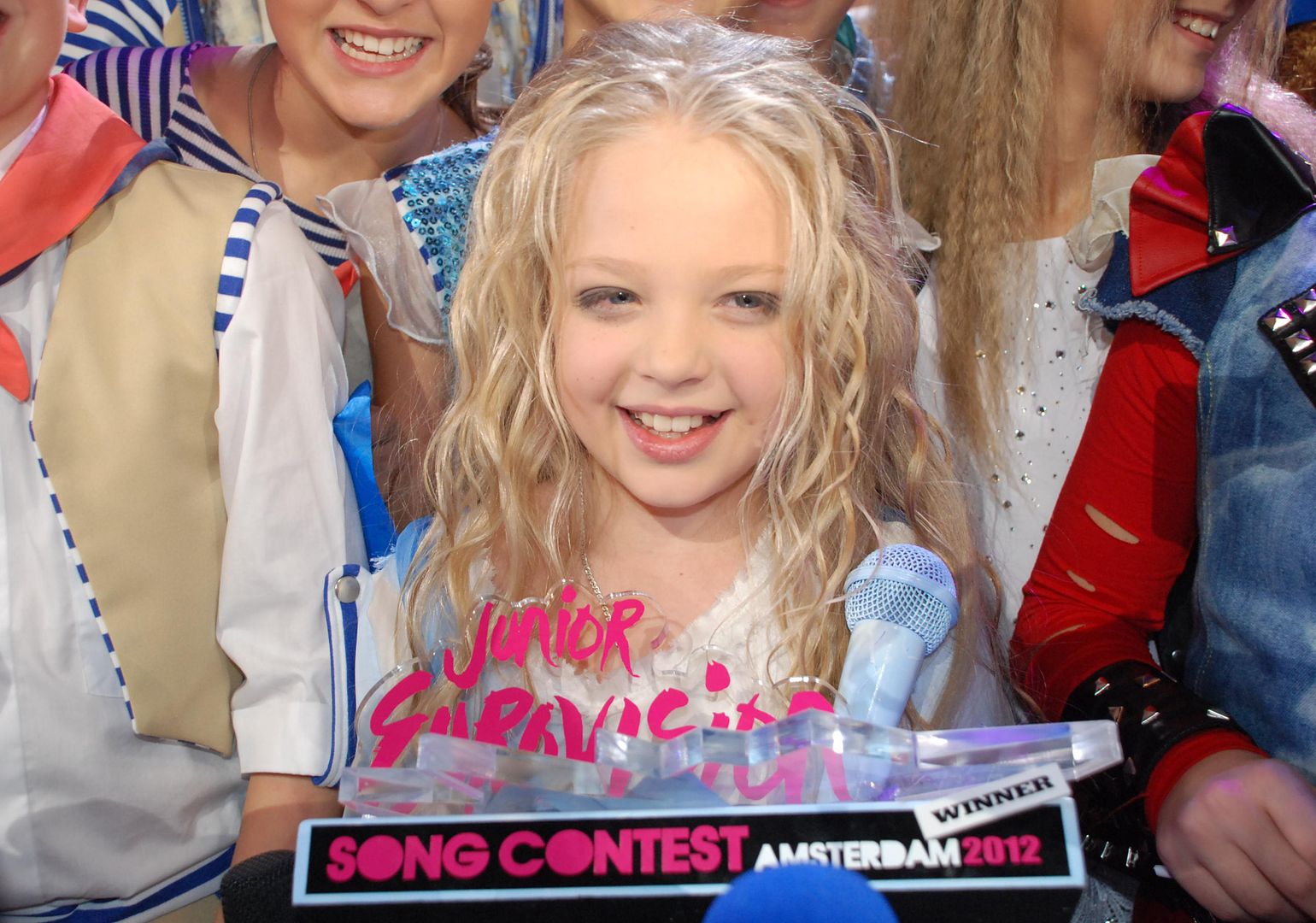
Anastasiya Petryk

Entries

01. Belarus: Egor Zheshko - A more-more (9th place, 56 points)
02. Sweden: Lova Sönnerbo - Mitt mod (6th place, 70 points)
03. Azerbaijan: Omar Sultanov & Suada Alekberova - Girls and Boys (Dünya Sənindir) (11th place, 49 points)
04. Belgium: Fabian Feyaerts - Abracadabra (5th place, 72 points)
05. Russia: Lerika - Sensatsiya (4th place, 88 points
06. Israel: Kids.il - Let the music win (8th place, 68 points)
07. Albania - Igzidora Gjeta - Kam një këngë vetëm për ju (12th place, 35 points)
08. Armenia: Compass Band - Sweety baby (3rd place, 98 points)
09. Ukraine: Anastasiya Petryk - Nebo (1st place, 138 points)
10. Georgia: Funkids - Funky lemonade (2nd place, 103 points)
11. Moldova: Denis Midone - Toate vor fi (10th place, 52 points)
12. The Netherlands: Femke Meines - Tik Tak Tik (7th place, 69 points)

Fabian

Format

The Junior Eurovision Song Contest 2012 was the tenth edition of the contest, and took place at the Heineken Music Hall in Amsterdam, Netherlands on December 1 2012. Dutch broadcaster AVRO was the the host broadcaster for the event. For the second time the Netherlands hosted the contest, after hosting the contest in 2007 in Rotterdam. The motto for the contest was Break The Ice.


The show was hosted by Ewout Genemans and Kim-Lian van der Meij and was opened with the song Euphoria, sung by Rachel. During the interval-actKim-Lian van der Meij sang the song Break The Ice, which was specially written for this contest. The 2009 winner Ralf Mackenbach performed also he sang his new hit. Twelve countries took part in the contest, making it the smallest number of countries participating in the Junior Eurovision Song Contest history, and equalling the number of countries participated in the 1970 Eurovision Song Contest held at RAI Congrescentrum. Israel, Albania and Azerbaijan made their debuts at the Junior Contest. Whilst nine countries from the previous edition continued their participation in the contest, four countries have withdrew: Lithuania, Bulgaria, Latvia and Macedonia. The contest was won by Anastasiya Petryk for Ukraine with the song Nebo. This is Ukraine's first Junior Eurovision victory and second Eurovision victory since Ruslana won in the 2004 Eurovision Song Contest in Istanbul.
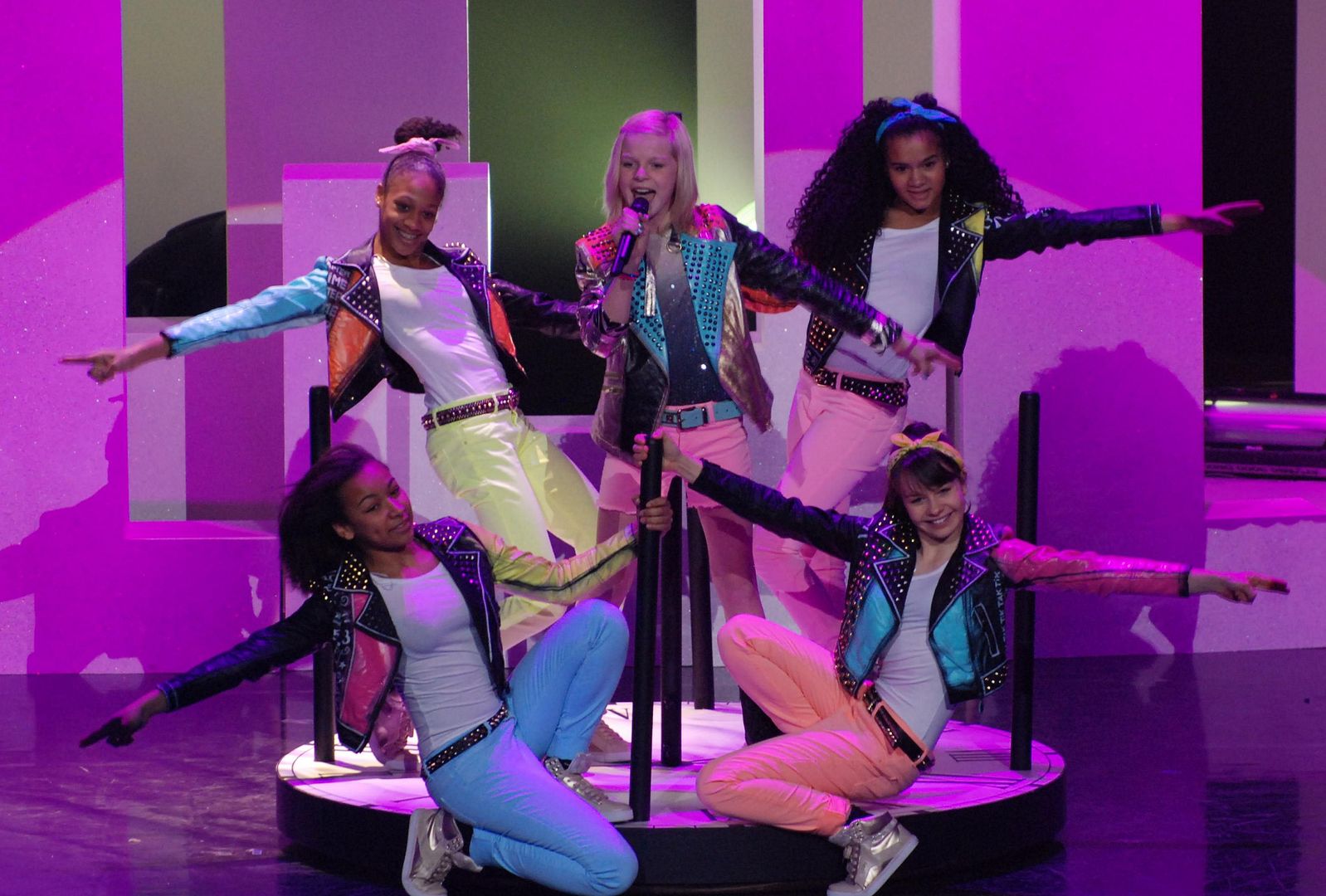
Femke

Venue

On 27 February 2012 it was announced that the Heineken Music Hall would be the venue for the tenth edition of the contest. The big hall is used for concerts, has a capacity of 5500 and is 3000 m². After parties are given in a smaller hall, with a capacity of 700. The Heineken Music Hall was specially designed for music shows,several artists like Madonna and Kylie Minogue made shows at the venue. Furthermore it is often used by the Dutch Entertainment Company Q-dance for the Event-Series X-Qlusive taking place several times a year. The architect was Frits van Dongen. The motto for the contest was announced on 6 September 2012 as Break The Ice. Tickets for the contest went on sale from 10 September 2012.

Returning artist

Lerika who participated for Moldova in 2011 finishing in 6th place with the song No, No, representedt Russia with the song Sensatsiya.

Saturday, 1 December 2012

Junior Eurovision Song Contest 2011


Date: December 3 2011
Venue: Karen Demirchyan Sports and Concerts Complex, Yerevan, Armenia
Presenters: Gohar Gasparyan, Avet Barseghyan
Host broadcaster: ARMTV
Interval act: Molly Sanden, Sirusho and Vladimir Arzumanyan
Number of entries: 13
Debuting countries: -
Returning coubtries: Bulgaria
Withdrawing countries: Malta, Serbia
Voting system: Citizens of each participating country vote by telephone and SMS message, which counts for 50%. Each country's 10 favourites are awarded 1 to 8, 10 and 12 points based on the number of votes. Results 1-5 are automatically displayed on-screen, then each country announces 6-8, 10 and 12 points. A jury in each country also has a 50% say in the outcome.
Winner: Candy music - CANDY, Georgia

CANDY

Entries

01. Russia: Katya Ryabova - Kak Romeo i Dzhulyetta (4th place, 99 points)
02. Latvia: Amanda Bašmakova - Mēness suns (13th place, 31 points)
03. Moldova: Lerika - No, no (6th place, 78 points)
04. Armenia: Dalita - Welcome to Armenia (5th place, 85 points)
05. Bulgaria: Ivan Ivanov - Supergeroy (8th place, 60 points)
06. Lithuania: Paulina Skrabytė - Debesys (10th place, 53 points)
07. Ukraine: Kristall - Evropa (11th place, 42 points)
08. F.Y.R. Macedonia: Dorijan Dlaka - Žimi ovoj frak (12th place, 31 points)
09. The Netherlands: Rachel - Ik ben een teenager (2nd place, 103 points)
10. Belarus: Lidiya Zablotskaya - Angely dobra (3rd place, 00 points)
11. Sweden: Erik Rapp - Faller (9th place, 57 points)
12. Gerogia: CANDY - Candy music (1st place, 108 points)
13. Belgium: Femke - Een kusje meer (7th place, 64 points)

Rachel

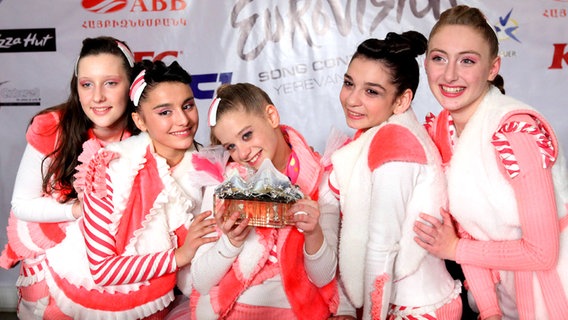
The Junior Eurovision Song Contest 2011 was the ninth edition of the contest, and took place in Yerevan, Armenia at the recently renovated Karen Demirchyan Sports and Concerts Complex. It was the first time in history of the Junior Eurovision Song Contest that the contest was held in last year's winning country. Public Television of Armenia ARMTV was the main organizer of the show, being provided financial aid from the European Broadcasting Union made of entrance fees from the participating broadcasters, while Swedish company HD Resources assisted with the technical side of the production.

The winner was the group Candy from Georgia with the song Candy Music. This is Georgia's second victory in the Junior Eurovision Song Contest.

Femke

Logo and graphic design

In May 2011, ARMTV announced a competition for children to design the official logo of the contest, which was due to be presented on June 1. However, in the end the logo was designed by a professional team from ARMTV, the EBU and Studio of Anton Baranov from Belarus, who also designed logo of Junior Eurovision Song Contest 2010 and was presented on July 15 2011. The logo depicts equalizer bars in the shape of a mountain, hinting to the famous Mount Ararat.

Participants

On 15 July, the EBU announced that 12 countries would compete in the upcoming contest. San Marino was to compete for the first time, while Latvia, Serbia and Malta withdrew. EBU also had been negotiating with several other countries, including Italy and Spain, but they were not able to confirm their participation due to the shortage of time. On 15 August, it was announced that Bulgaria had joined the list, returning after a two-year absence from the contest. On 9 September Latvia reversed its decision to withdraw from the contest and would now send a participant. However, on October 7 it was announced that San Marino would not be present in Armenia as they were not able to find a suitable participant in time for the contest, hoping to send an entry to the 2012 edition. Therefore a total of 13 countries took part in Armenia.

Erik Rapp

Voting rules changes

Changes to the voting included that televoting was possible after all songs had been performed, and not from the beginning of the show as in previous years – returning to the rules active in 2003–2005. Each country's spokesperson also announced all the points during their presentation, due to the lower number of participating countries, as it was done in 2003–2004.

Returning artists

Even though rules of Junior Eurovision do not allow participation of returning artists - EBU issued special permission for Russian entry 2011 performed by participant of Junior Eurovision Song Contest 2009 Ekaterina Ryabova, which is first similar case in history of the contest. According to Sietse Bakker, EBU coordinator - EBU may also drop this rule completely, starting from 2012. Notably, Ekaterina had also already applied to national preselection in 2010 as well, but was disqualified following the existing rule.

Friday, 30 November 2012

Junior Eurovision Song Contest 2010


Date: November 20 2010
Venue: Minsk Arena, Minsk, Belarus
Presenters: Denis Kourian, Leila Ismailava
Host broadcaster: BTRC
Opening act: Ksenia Sitnik and Alexey Zhigalkovich singing Hello, Eurovision
Interval act: Alexander Rybak singing Europe's Skies, all participants and Dmitry Koldun singing A Day Without War, Winners of Junior Eurovision 2003-2009
Number of entries: 14
Debuting countries: Moldova
Returning coubtries: Latvia, Lithuania
Withdrawing countries: Cyprus, Romania
Voting system: Citizens of each participating country vote by telephone and SMS message, which counts for 50%. Each country's 10 favourites are awarded 1 to 8, 10 and 12 points based on the number of votes. Results 1-5 are automatically displayed on-screen, then each country announces 6-8, 10 and 12 points. A jury in each country also has a 50% say in the outcome.
Winner: Mama - Vladimir Arzumanyan, Armenia

Vladimir Arzumanyan

Entries

01. Lithuania: Bartas - Oki doki (6th place, 67 points)
02. Moldova: Ștefan Roșcovan - Ali Baba (8th place, 54 points)
03. The Netherlands: Anna & Senna - My family (9th place, 52 points)
04. Serbia: Sonja Škorić - Čarobna  (3rd place, 113 points)
05. Ukraine: Yulia Gurska - Miy litak (14th place, 28 points)
06. Sweden: Josefine Ridell - Allt jag vill ha (11th place, 48 points)
07. Russia: Sasha Lazin & Liza Drozd - Boy and girl (2nd place, 119 points)
08. Latvia: Šarlote Lēnmane & Sea Stones - Viva la dance (10th place, 51 points)
09. Belgium: Jill & Lauren - Get up! (7th place, 61 points)
10. Armenia: Vladimir Arzumanyan - Mama (1st place, 120 points)
11. Malta: Nicole Azzopardi - Knock knock!..Boom! Boom! (13th place, 35 points)
12. Belarus: Daniil Kozlov - Muzyki svet (5th place, 85 points)
13. Georgia: Mariam Kakhelishvili - Mari dari (4th place, 109 points)
14. F.Y.R. Macedonia: Anja Vetrova - Eooo, Eooo (12th place, 38 points)

The Junior Eurovision Song Contest 2010 was the eighth edition of Junior Eurovision Song Contest and took place in Minsk, Belarus. It was held on 20 November 2010. The contest was won by Vladimir Arzumanyan of Armenia with the song Mama. This gave Armenia its first Junior Eurovision victory.

Anna & Senna

Location

The European Broadcasting Union (EBU) invited broadcasters to bid for the rights to host the Junior Eurovision Song Contest 2010. Belarus broadcaster National State Television and Radio Company of the Republic of Belarus (BRTC) won the rights to organise the contest over bids from Russia and Malta. Under construction through 2009, the 15,000-spectator Minsk Arena hosted the event. Belarus has twice previously won the Junior Eurovision Song Contest, which is, according to EBU Executive Supervisor Svante Stockselius, one of Belarus' most popular television shows.

Visual design

The theme art for the contest was revealed on April 8 2010, consisting of multi-coloured circles, symbolising different people, cultures and countries, that form the shape of wings, that symbolise freedom, ease of flying, creative inspiration and rising above. On  September 8, the mascots of the show were presented, being a bear and a wisent.

Jill & Lauren

The stage, by Swedish stage designer Ulf Mårtensson, was unveiled on July 15 2010, featuring five constructions in the shapes of wings. The hosts were also involved with each performance on their own dedicated section of the stage.

Theme art was also incorporated in the promotional billboards and posters featuring 11 faces of Junior Eurovision selected through casting procedure. Results of castings were revealed on 20 July 2010 and the 11 chosen ones were Belarus TV personalities Denis Kourian, Olga Barabanschikova, Irina Kazantseva, Andrey Bibikov, former JESC entrants Alexey Zhigalkovich, Ksenia Sitnik, Yuriy Demidovich, Alina Molosh, Daria Nadina as well as non-professionals Yulia Brazhinskaya and Ilya Ilmursky.

Sonja Škorić

Participants

On 28 July 28 2010, the EBU announced the competing countries for the Junior Eurovision Song Contest 2010. A total of 14 countries competed, with Moldova making its début and Latvia and Lithuania returning. Cyprus and Romania withdrew from the contest. Sweden returned to the contest through Sveriges Television (SVT) after TV4 withdrew. The EBU's coordinator of the contest, Svante Stockselius, labelled SVT's return to the contest as a big achievement in terms of negotiations with possible participants and expressed hope that other Scandinavian broadcasters may also return to the show.

The show also featured all winners of Junior Eurovision Song Contest 2003-2009 Dino Jelusić, María Isabel, Ksenia Sitnik, The Tolmachevy Twins, Alexey Zhigalkovich, Bzikebi and Ralf Mackenbach, who performed remix-medley of their winning entries and presented the trophy to the winner of 2010 edition. Also, a special documentary Kids of Eurovision was filmed by BTRC about them.


Wednesday, 28 November 2012

Junior Eurovision Song Contest 2009


Date: November 21 2009
Venue: Palace of Sports, Kiev, Ukraine
Presenters: Ani Lorak, Timur Miroshnichenko, Dmytro Borodin
Host broadcaster: NTU
Opening act: Dance acts featuring perofmance of Karina Rudnycka & Yuriy Kuzynsky
Interval act: Ani Lorak
Number of entries: 13
Debuting countries: -
Returning coubtries: Sweden
Withdrawing countries: Bulgaria, Greece, Lithuania
Voting system: Citizens of each participating country vote by telephone and SMS message, which counts for 50%. Each country's 10 favourites are awarded 1 to 8, 10 and 12 points based on the number of votes. Results 1-5 are automatically displayed on-screen, then each country announces 6-8, 10 and 12 points. A jury in each country also has a 50% say in the outcome.
Winner: Click Clack - Ralf Mackenbach, The Netherlands

Ralf Mackenbach

Entries

01. Sweden: Mimmi Sandén - Du (6th place, 68 points)
02. Russia: Ekaterina Ryabova - Malenkiy prints (2nd place, 116 points)
03. Armenia: Laura Hayrapetyan - Barcelona (2nd place, 116 points)
04. Romania: Ioana Anuta - Ai puterea în mâna ta (13th place, 19 points)
05. Serbia: Ništa Lično - Onaj pravi (10th place, 34 points)
06. Georgia: Princesses - Lurji prinveli (6th place, 68 points)
07. The Netherlands: Ralf Mackenbach - Click Clack (1st place, 121 points)
08. Cyprus: Rafaella Kosta - Thalassa, ilios, aeras, fotia (11th place, 32 points)
09. Malta: Francesca & Mikaela - Double trouble (8th place, 55 points)
10. Ukraine: Andranik Alexanyan - Try topoli, try surmy (5th place, 89 points)
11. Belgium: Laura Omloop - Zo verliefd (Yodelo) (4th place, 113 points)
12. Belarus: Yuriy Demidovich - Volshebniy krolik (9th place, 48 points)
13. F.Y.R. Macedonia: Sara Markovska - Za ljubovta (12th place, 31 points)

Laura Omloop

The Junior Eurovision Song Contest 2009 was the seventh edition of Junior Eurovision Song Contest and took place in Kiev, Ukraine. It was scheduled for  November 21. 13 countries were confirmed by the European Broadcasting Union (EBU) to compete in the Contest. The contest was won by Ralf Mackenbach for the Netherlands with the song Click Clack. At the age of 14, he is the oldest person to win the Junior Eurovision Song Contest in its 7 year History. Luara Hayrapetyan achieved Armenia another second place. Ekaterina Ryabova also took second place for Russia.

Location

The European Broadcasting Union (EBU) invited broadcasters to bid for the rights to host the Junior Eurovision Song Contest 2009; three bids were received from Belarus, Serbia, and Ukraine. TV4 of Sweden had originally sent in a bid during summer 2007, but soon withdrew its bid after deciding to completely withdraw from the contest. After deliberations by the EBU, National Television Company of Ukraine was granted the rights to the 2009 contest and will host it in Kiev. Ukraine also hosted the Eurovision Song Contest 2005 at the same venue.

Ekaterina Ryabova

Concept and logo


Logo of the contest titled Tree of life is based on the artwork Sunflower of life by Maria Primachenko, a well known Ukrainian folk art painter. Creative design of the show was based on the logo of the contest, works and ideas of Primachenko as well as on the concept of the show, titled For the joy of people.

Participants

The EBU announced the complete list of participating countries in the 2009 Contest on 8 June 2009. 13 countries competed in the contest: Armenia, Belarus, Belgium, Cyprus, Georgia, Macedonia, Malta, Netherlands, Romania, Russia, Serbia,Sweden and Ukraine. Sweden returned after missing the contest, while Bulgaria, Greece and Lithuania withdrew from the Contest.


Sunday, 25 November 2012

Junior ESC 2012 - The Netherlands


Singer: Femke
Song: Tik tak tik
Composer: Femke Meines, Anne Kees Meines, Tjeerd Oosterhuis
Lyricist: Femke Meines, Anne Kees Meines

Femke is a 12-year old girl who lives with her 3 little sisters and her parents in Tuitjenhorn, a small village in north-west of The Netherlands. Last year Femke already tried to reach the finals of the Dutch national selection, but this year she took revenge by winning it with the song Tik, Tak, Tik that she wrote herself.

Because she believes time is going too fast, she wishes to freeze the time. Femke has the desires to do a million things like feeding the cat or taking the dog out for a walk, but the only thing she really wants is to stay forever young and never grow up.
The producer of her song is Tjeerd Oosterhuis, who was also responsible for the winning Junior Eurovison song of Ralf, Click Clack in 2009.
Femke is a typical bubbling girl who loves to sing and dance, but also finds enough time to skeeler, swim or eat lots of chocolate. Her biggest dream is to be a famous singer. But when this goal will not be reached, she wants to become a hairdresser or maybe a maternity assistant.
The Netherlands will be hosting this year’s Junior Eurovision Songcontest. Femke is very proud that the 10th anniversary will take place in Amsterdam; she loves to show Europe how beautiful her country is.
She’s enjoys the advantage of staying for the Contest in the Netherlands which means she doesn’t have to travel to another country because Femke has fear of flying. She is really looking forward to make a big party on the Eurovision stage and hopes that she can freeze the European time with her spectacular moving clock-act.


Junior ESC 2012 - Moldova


Singer: Denis Midone
Song: Toate Vor Fi
Composer: Marian Stircea
Lyricist: Radmila Paraschiv

Denis Midone (10) won the right to represent Moldova at the 2012 Junior Eurovision Song Contest and is a talented singer who has already participated in several children competitions and also won some of them.

Denis Midone was born in Petah Tikva, Israel on June 14 2002 and currently lives in Chisinau, Moldova, where he studies Romanian and Spanish at the Cervantes School.

Since 2009 he is a member of the vocal ensemble Do-Re-Michy at the Children and Youth Creativity CentreGiochel. Some of his impressive song contest participations include a 3rd place at the 2010 Sanremo Junior in Italy and victories at the International Art Festival Jezerski Perle 2010 or the 2012 Slavic Bazaar Vitebsk.

Denis is looking forward to this new great adventure which is the 2012 Junior Eurovision Song Contest in Amsterdam.


Junior Eurovision Song Contest 2008


Date: December 22 2008
Venue: Spyros Kyprianou Athletic Centre, Lemesos, Cyprus
Presenters: Alex Michael, Sophia Paraskeva
Host broadcaster: CyBC
Opening act: Dance act featuring Yiorgos Ioannides and Mariam Venizelou.
Interval act: Dima Bilan, Evridiki & Dimitris Korgialas, all JESC 2008 participants singing Hand in Hand
Number of entries: 15
Debuting countries: -
Returning coubtries: -
Withdrawing countries: Portugal, Sweden
Voting system: Citizens of each participating country vote by telephone and SMS message, which counts for 50%. Each country's 10 favourites are awarded 1 to 8, 10 and 12 points based on the number of votes. Results 1-5 are automatically displayed on-screen, then each country announces 6-8, 10 and 12 points. A jury in each country also has a 50% say in the outcome.
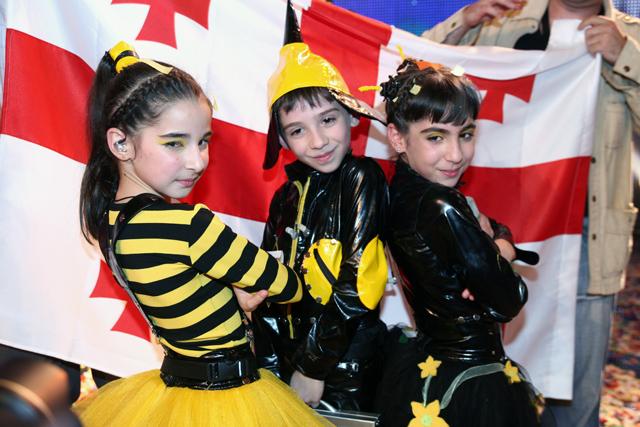
Winner: Bzz.. - Bzikebi, Georgia

Bzikebi

Entries

01. Romania: Mădălina & Andrada - Salvaţi planeta! (9th place, 58 points)
02. Armenia: Monica - Im Ergi Hnchyune (8th place, 59 points)
03. Belarus: Dasha, Alina & Karyna - Sertse Belarus (6th place, 86 points)
04. Russia: Mihail Puntoc - Spit angel (7th place, 73 points)
05. Greece: Niky Yiannouchu - Kapoia nychta (14th place, 19 points)
06. Georgia: Bzikebi - Bzz.. (1st place, 154 points)
07. Belgium: Oliver - Shut up (11th place, 45 points)
08. Bulgaria: Krastyana Krasteva - Edna mechta (15th place, 15 points)
09. Serbia: Maja Mazić - Uvek kad u nebo pogledam (12th place, 37 points)
10. Malta: Daniel Testa - Junior swing (4th place, 100 points)
11. The Netherlands: Marissa - 1 dag (13th place, 27 points)
12. Ukraine: Victoria Petryk - Matrosy (2nd place, 135 points)
13. Lithuania: Eglė Jurgaitytė - Laiminga diena (3rd place, 103 points)
14. F.Y.R. Macedonia: Bobi Andonov - Prati mi SMS (5th place, 93 points)
15. Cyprus: Elena Mannouri & Charis Savva - Gioupi gia (10th place, 46 points)

Format

The Junior Eurovision Song Contest 2008 was the sixth Junior Eurovision Song Contest, which is the world's largest song contest for children. It was held at the Spyros Kyprianou Athletic Centre in Lemesos, Cyprus and hosted by Alex Michael and Sophia Paraskeva. It was won by the Georgian trio Bzikebi, with the song Bzz... This is the first song to win any Eurovision Song Contest in an imaginary language. Ukraine took 2nd place and Lithuania finished 3rd.

Marissa

The theme of the event was Fun in the Sun, despite the fact that there were thunderstorms in Lemesos the day of the contest. The stage, which was designed by George Papadopoulos was nominated for the prestigious international Live Design Excellence Awards. The design is an abstract composition and consists of a round stage representing the island of Cyprus, real water along the front of the stage, two jetties, the waves breaking and moving away from the island and five sailing boats with oars.

For the contest, various changes to the rules were made. One was that adults could assist children to write the songs submitted to their national broadcaster; previously only children could write the songs, with no assistance from adults. Another change was only six people could be on stage during a performance, instead of eight. The most significant change, however, was only half of the vote was decided by the tele-voters. Before the 2008 contest tele-voters completely decided the whole result. The other half of the result was decided by a jury of adults and children.

On May 27, 2007 the Eurovision Steering Group decided to award CyBC of Cyprus to host the 2008 contest, over TV4 of Sweden and NTU of Ukraine. On 10 September 2008 the hosts were announced as Alex Michael and Sophia Paraskeva; both presenters with Cypriot backgrounds. On 13 October 2008 the draw of the running order took place live on CyBC1. This involved drawing the first and last countries and performers, and then drawing countries into various 'pots' to decide when they would perform. The full running order was announced on 14 October 2008. The stage was constructed between 30 October 2008 and 14 November 2008.

Victoria Petryk

Voting

As in all previous Eurovision Song Contests each country gave their top 10 countries songs points from 1 point for their 10th favourite song up until 8 points for their 3rd favourite song. Then 10 and 12 points were given for the second favorite and favorite respectively. But, the difference between this contest and other past contests is this is the first Eurovision Song Contest that implements a jury vote that counts for half of each countries vote.

Only Ukraine calculated their vote using a jury. Ukrainian broadcaster NTU opted not to broadcast the contest live, but to air it deferred on Sunday, November 23 as Saturday, November 22 is Holodomor Remembrance Day in the country.

Participating countries


Fifteen countries took part in the Junior Eurovision Song Contest: Armenia, Belarus, Belgium, Bulgaria, Cyprus, Macedonia, Georgia, Greece, Lithuania, Malta, Netherlands, Romania, Russia, Serbia, and Ukraine. Portugal, which had taken part twice since 2006 announced that it was no longer interested in the contest and withdrew along with Sweden, a founding country in 2003, which left because of other broadcasting plans during the time of the event. On the other hand, Israel and Bosnia & Herzegovina announced their intention to participate, but both decided to withdraw before the contest. Azerbaijan announced its intention to take part also, but withdrew from the contest in early October. According to İctimai Televiziya və Radio Yayımları Şirkəti, the network was unable to select and prepare children for such a high scale event without proper help from other governmental structures and bodies. The broadcaster also confirmed payment of a fine to the EBU due to its late withdrawal. Poland had also considered participation but decided that it would not take part this year. The 2008 contest was the first Junior Eurovision Song Contest to have no debuting countries.