Monday, 20 August 2012

Eurovision Song Contest 1965

France Gall

Date: March 20, 1965
Venue: Sala di Concerto della RAI, Naples, Italy
Presenter: Renata Mauro
Orchestra: Rai Concert Orchestra
Conductor: Gianni Ferrio
Director: Romolo Siena
Scruteneer: Miroslav Vilcek
Host broadcaster: RAI
Price presenter: Mario Del Monaco
Interval act: Mario Del Monaco
Duration: 1 hour, 41 minutes
Number of entries: 18
Debuting countries: Ireland
Returning countries: Sweden
Withdrawing countries: -
Winning Song: Poupée de cire, poupée de son - France Gall - Luxembourg
Voting system:  Each country had 10 jury members who distributed three points among their one, two, or three favourite songs. The points were totalled and the first, second, and third placed songs were awarded 5, 3, and 1 votes in order. If only one song got every point within the jury it would get all 9 points. If only two songs were chosen, the songs would get 6 and 3 points in order.

Entries

01. The Netherlands: Conny van den Bos - 't is genoeg (11th place, 5 points)
02. UK: Kathy Kirby - I belong (2nd place, 26 points)
03. Spain: Conchita Bautista - ¡Qué bueno, qué bueno! (15th place, 0 points)
04. Ireland: Butch Moore - Walking the streets in the rain (6th place, 11 points)
05. Germany: Ulla wiesner - Paradies, wo bist du (15th place, 0 points)
06. Austria: Udo Jürgens - Sag ihr, ich lass sie grüßen (4th place, 16 points)
07. Noway: Kirsti Sparboe - Karulsell (13th place, 1 point)
08. Belgium: Lize Marke - Als het weer lente is (15th place, 0 points)
09. Monaco: Marjorie Noël - Va dire à l'amour (9th place, 7 points)
10. Sweden: Ingvar Wixell - Absent friend (10th place, 6 points)
11. France: Guy Mardel - N'avoue jamias (3rd place, 22 points)
12. Portugal: Simone de Oliveira - Sol de inverno (13th place, 1 point)
13. Italy: Bobby Solo - Se piangi, se ridi (5th place, 15 points)
14. Denmark: Birgit Brüel - For din skyld (7th place, 10 points)
15. Luxembourg: France Gall - Poupée de cire, poupée de son (1st place, 32 points)
16. Finland: Viktor Klimenko - Aurinko laskee länteen (15th place, 0 points)
17. Yugoslavia: Vice Vukov - Čežnja (12th place, 2 points)
18. Switzerland: Yovanna - Non, à jamais sans toi (8th place, 8 points)
Conny van den Bos

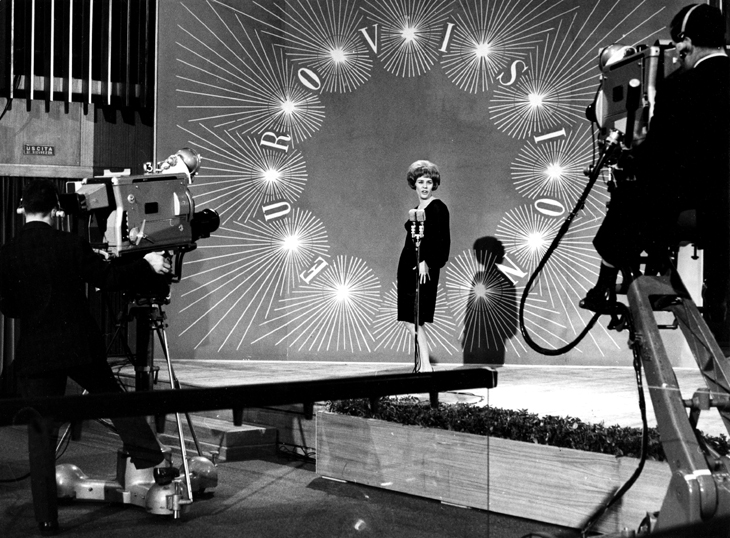
The Eurovision Song Contest 1965 was the 10th in the series. Luxembourg won the contest with the song Poupée de cire, poupée de son, performed by France Gall and written by Serge Gainsbourg. As is common with Gainsbourg's lyrics, the words are filled with double meanings, wordplay, and puns. The title can be translated as Wax doll, Sawdust doll (a floppy doll stuffed with sawdust) or as Doll of wax, Doll of sound (with implications that Gall is a singing doll controlled by Gainsbourg). This was Luxembourg's second win in the contest. The 1965 contest marked the debut of Ireland, a country which later went on to dominate the competition. 

Location

The venue for the 1965 contest was at the Sala di Concerto della RAI (RAI Production Centre of Naples). The building was founded in the late fifties and early sixties, and is located in Viale Marconi 9, in the district of Fuorigrotta, near the Stadio San Paolo. The structure has three TV studios for a total of 1227 m². and capacity of 370 persons, used for the filming of programs and fiction and an auditorium . The Neapolitan song archives, are also housed here.

Format

Italy's hosting of the contest was its first. Participation of 18 countries, also meant the contest reached its highest ever number. After a year of absence, Sweden returned to the competition and Ireland debuted. Belgium, Germany, Finland and Spain all scored nul points while Luxembourg won for the second time with the highly controversial Poupée De Cire, Poupée De Son sung by teenager France Gall which later went on to be a massive hit in almost all European countries. The competition was also broadcast via the Intervision network, to the Eastern European nations for the very first time.

 Viktor Klimenko

Participating countries

Sweden returned after a one-year absence, and Ireland debuted in the competition. Belgium, Finland, Germany, and Spain each scored null points for the second time. Ingvar Wixell, the Swedish participant performed his song in English instead of the original Swedish title Annorstädes Vals. The native languages were used for all of the other participants. This led to a rule being introduced, that meant all participants had to perform their songs using one of their national languages.

Returning artists

Three artists returned for a second time in this year's contest. Udo Jürgens from Austria who's previous participation was in 1964; Conchita Bautista from Spain, previously representation in 1961; and Vice Vukov from Yugoslavia, who last participated in 1963.


Sunday, 19 August 2012

Alcazar


Alcazar was a Swedish eurodance group which has established themselves as one of Sweden's most successful music groups with a string of hits since their debut single in 1999. Worldwide, Alcazar sold over 12 million records between 2001 and 2004. Alcazar have also had success around the world with their song Crying at the Discoteque, having charted in countries such as USA, Brazil, Australia, Japan and most countries in Europe. Alcazar disbanded indefinitely in August 2011 after a concert at Stockholm Pride.

Biography

The group formed in 1998 with three members: Andreas Lundstedt, Tess Merkel  and Annika Kjærgaard. Their first single, Shine On, was a hit in Sweden, but with their second release, Crying at the Discoteque they achieved success across Europe. Both singles appeared on their debut album, Casino, written and produced by Swedish record producers Alexander Bard and Anders Hansson. Later editions of Casino contained a cover of The Human League's hit Don't You Want Me which also served as the third single off the album. In the United States, Alcazar gained moderate success. Crying at the Discoteque peaked at #44 and Don't You Want Me peaked at #30 on the Hot Dance Music/Club Play.

In December 2002, Andreas Lundstedt's boyfriend at the time, Magnus Carlsson, joined the group. The second album, Alcazarized, was released in Sweden in 2003 and became a big hit. Subsequently, it was released internationally in 2004, with new cover artwork and a slightly different track list.

In the autumn of 2004, Alcazar released This Is the World We Live In. The song samples Diana Ross's 1980 hit single Upside Down and re-uses lyrics from Genesis' 1986 single Land of Confusion. Their follow-up single, Physical, also sampled an older hit: Londonbeat's I've Been Thinking About You. The singles were followed up by the album Dancefloor Deluxe which was released in Sweden in August 2004. In the winter of 2004/2005, they released the Christmas single Here I Am. Alcazar enjoyed considerable success in 2004 in their home country Sweden. 2005 saw the release of the single Start the Fire. During the making of its music video, Annika Kjærgaard had an accident in which she broke her foot.

In the autumn of 2005, the band decided to take a break. Andreas moved on to musicals and played the lead in Saturday Night Fever, while Tess became a poker pro.

In May 2007, the band did a one-off performance in London at the night club G-A-Y, together with Swedish colleagues BWO and Army Of Lovers, and invited their friend Lina Hedlund to join them on stage. It all turned out to be a very successful combination and a few months later the New Alcazar was formed.

In January 2008, their first and comeback single We Keep on Rockin', witten and produced by Anders Hansson, was released. The single quickly turned into a hit and only a week after the release the single passed gold status in sales. In March 2009, the new album Disco Defenders was released in Sweden. Disco Defenders has received great reviews from the Swedish critics.

In 2010, Alcazar recorded a duet with British pop group Same Difference, entitled Karma Karma. It was included on Same Difference's second album The Rest Is History Although not officially released as a single, the song charted on Swedish iTunes thanks to Alcazar's popularity in their homeland.


Break and line-up changes

The band claimed that they needed a break during the autumn of 2005. Male lead singer, Andreas Lundstedt claimed that the band would be back in the summer of 2007. In the meantime the male members launched solo careers. Lundstedt had appeared in the Eurovision Song Contest 2006, as a member of six4one, a multi-national band founded for the sole purpose of representing Switzerland at the contest, whilst Carlsson has twice taken part individually in the Swedish Melodifestivalen.

Lina Hedlund was announced as the replacement for Annika. Lina Hedlund has previously entered Melodifestivalen on two occasions. Andreas' 'Expressen' blog was recently updated, telling Alcazar fans that the group will now be back together permanently, they will take part in a concert in Sweden in December 2007 and will then head into the studio to produce the group's third studio album, with new member, Lina Hedlund. The band is now including Tess Merkel and Lina Hedlund as female vocalists, and Andreas Lundstedt as male vocalist.

Melodifestivalen

Alcazar have taken part in Melodifestivalen on numerous occasions. In 2003, Not a Sinner, Nor a Saint initially failed to qualify for the final, but got a wildcard in the second chance round, finishing 3rd overall. However, the song eventually became the biggest hit of all participating songs in Melodifestivalen 2003. It was Alcazar's first number 1 single in Sweden and was certified Gold.

During early 2005 Alcazar was offered a spot in the United Kingdom national selection for Eurovision Song Contest 2005 but refused the offer. Instead they tried their luck in Melodifestivalen 2005 with the disco tune Alcastar. As in 2003, they originally failed to qualify for the final, but eventually made it through after the second chance semi-final. And once again, the group again had to settle for the 3rd place in the final, the song was a hit and became Alcazar's second number 1 single in Sweden.

Alcazar are once again participating in Melodifestivalen 2009, this time with the song Stay the Night. After performing the song during the first semifinal in Scandinavium, Gothenburg, they finished in the top 2 of a Melodifestivalen semifinal for the first time, thus qualifying directly for the final. In the final in Globen, having placed 3rd with the regional juries and 4th in the televote, the song finished 5th overall. The song managed to peak at number 2 on Swedish Singles Charts giving Alcazar another Top 10 single in Sweden. Alcazar also participated in Melodifestivalen 2010 with the song Headlines, written and produced by Tony Nilsson and Peter Boström, but failed to reach the final.

Saturday, 18 August 2012

Eurovision Song Contest 1964

Gigliola Cinquetti

Date: March 21, 1964
Venue: Tivolis Koncertsal, Copenhagen, Denmark
Presenter: Lotte Wæver
Orchestra: Grand Prix Orchestra
Conductor: Kai Mortensen
Director: Poul Leth Sørensen
Scruteneer: Miroslav Vilcek
Host broadcaster: DR
Price presenter: Svend Pedersen
Interval act: Ballet Harlequinade
Duration: 1 hour, 35 minutes
Number of entries: 16
Debuting countries: Portugal
Returning countries: -
Withdrawing countries: Sweden
Winning Song: Non Ho L'età - Gigliola Cinquetti, Italy
Voting system: Each country had 10 jury members who distributed three points among their one, two, or three favourite songs. The points were totalled and the first, second, and third placed songs were awarded 5, 3, and 1 votes in order. If only one song got every point within the jury it would get all 9 points. If only two songs were chosen, the songs would get 6 and 3 points in order.

Entries:

01. Luxembourg: Hugues Aufray - Dès que le printemps revient (4th place, 14 points)
02. The Netherlands: Anneke Grönloh - Jij bent mijn leven (10th place, 2 points)
03. Norway: Arne Bendiksen - Spiral (8th place, 6 points)
04. Denmark: Bjørn Tidmand - Sangen om dig (9th place, 4 points)
05. Finland: Lasse Mårtenson - Laiskotellen (7th place, 9 points)
06. Austria: Udo Jürgens - Warum nur warum (6th place, 11 points)
07. France: Rachel - Le chant de Mallory (4th place, 14 points)
08. UK: Matt Monro - I love the little things (2nd place, 17 points)
09. Germany: Nora Nova - Man gewöhnt sich so schnell ...  (13th place, 0  points)
10. Monaco: Romuald - Où sont-elles passées (3rd place, 15 points)
11. Portugal: António Calvário - Oração (13th place, 0 points)
12. Italy: Gigliola Cinquetti - Non ho l'età (1st place, 49 points)
13. Yugoslavia: Sabahudin Kurt - Život je sklopio krug (13th place, 0 points)
14. Switzerland: Anita Traversi - I miei pensieri (13 th place, 0 points)
15. Belgium: Robert Cogoi - Près de ma rivière (10th place, 2 points)
16. Spain: Tim, Nelly & Tony - Caracola (12th place, 1 point)

Anneke Grönloh

The Eurovision Song Contest 1964 was the ninth Eurovision Song Contest. It was held in Copenhagen, the capital of Denmark after the Danish victory the previous year. Italy won the contest for their first time scoring 49 points with the song Non ho l'età, performed by Gigliola Cinquetti and written by Nicola Salerno and Mario Panzeri.

Location

The venue choice for the contest was Denmark's famous amusement park and pleasure garden Tivoli Gardens. The park opened on August 15, 1843 and is the second oldest amusement park in the world, after Dyrehavsbakken in nearby Klampenborg. The amusement park was first called Tivoli & Vauxhall; Tivoli alluding to the Jardin de Tivoli in Paris, and Vauxhall alluding to the Vauxhall Gardens in London.

Format

A political protest occurred after the Swiss entry: a man trespassed onto the stage holding a banner that read Boycott Franco & Salazar. Whilst this was going on, television viewers were shown a shot of the scoreboard; once the man was removed the contest went on.

The immediate response of the Koncertsal audience to the Italian entry was markedly enthusiastic and prolonged and, most unusually for a contest performance, after leaving the stage Gigliola Cinquetti was allowed to return to take a second bow. Her performance was given an unscheduled repeat on British television the following afternoon. In the event, she won the most crushing victory in the history of the contest, with a score almost three times that of her nearest rival, a feat extremely unlikely ever to be beaten under the post-1974 scoring system.

Lotte Wæver

As with the 1956 contest, no video recording of the actual contest performance is known to survive (although one does of the shorter winning reprise); however like the 1956 contest an audio recording does exist. Reports say that this is because there was a fire at the studios of DR, the Danish broadcaster, in the 1970s. No other broadcaster recorded the entire show (although segments of the contest do exist in the archives of NDR Germany) other than for the Winners' reprise.

Participating countries

Sweden did not participate because of a boycott by singers. They did however broadcast it. Portugal made its début in the contest, however they became the first country to score nul points on their début. Germany, Switzerland, and Yugoslavia also scored nul points for the first time. The Netherlands became the first country to send a singer of non-European ancestry, Anneke Grönloh was of Indonesian descent.

Returning artists

Only one artist returned to the contest this year, with Anita Traversi representing Switzerland again, after previously participation in 1960.

The German song, Man gewöhnt sich so schnell an das Schöne. is the song with the longest title in Eurovision history, with 34 letters, two more than the second longest, Warum es hunderttausend Sterne gibt, the Austrian entry to the Eurovision Song Contest 1967.


Friday, 17 August 2012

Charlie McGettigan


Charles (Charlie) McGettigan (born in Ballyshannon, County Donegal on December 7 1950) is an Irish singer. He lives in Drumshanbo, Co. Leitrim.

Charlie came 3rd with 14 points at he Irish national final for the ESC in 1984 with the song Bee Bop Delight which was written by himself. In 1987 he participated again at the Irish national final with the song Are you shy which was also written by Charlie himself. The song finished in 3rd place with 75 points. For his album The man from 20, Charlie recorded a new version of Are you Shy.

In 1994 Charlie won, together with Paul Harrington, the Irish national final and the ESC in Dublin with the song Rock'n roll kids.

He made an appearance as a guest singer at Congratulations, the 50th anniversary concert of Eurovision.


Regina


In 1993 Regina participated for the first time at EMA, the Slovenian pre-selection for the ESC. Regina finished in 4th place with the song Naj ljubezen združi vse ljudi which was written by Marij Kogoj and Mojmir Sepe.

Regina (born Irena Jalšovec, July 4 1965, Murska Sobota, Yugoslavia — now Slovenia) is a Slovenian singer, best known for her participation at the ESC in 1996 in Oslo where she came 21st with the song Dan najlepših sanj.

As a child Regina sang in a choir and learned to play guitar and organ. In 1986 Regina began her study as a psychologist at the Ljubljana Universaty where she met her husband, the rock guitarist and composer Aleksander Kogoj. Since 1987 Aleksander produced many songs for Regina.

Regina paticipated seven times at EMA, the slovenian national final for the ESC:

  •  1993: Naj ljubezen združi vse ljudi - 4th
  •  1996: Dan najlepših sanj - 1st
  •  1998: Glas gora - 3rd
  •  2001: Zaljubljena v maj - 10th
  •  2002: Ljubezen daje moč - Semi-final
  •  2004: Plave očij - 12th
  •  2005: Proti vetru - 9th
Regina has released seven albums and currently combines her singing and voiceover career with audio production work.


Eurovision Song Contest 1963

Grethe & Jørgen Ingmann

Price presenter: Steward Hood
Interval act: - Ola & Barbro
Duration: 1 hour, 38 minutes
Number of entries: 16
Debuting countries: -
Returning countries: -
Withdrawing countries: -
Winning Song: Dansevise - Grethe & Jørgen Ingmann, Denmark
Voting system: Each country had 20 jury members who awarded their five favourite songs 5, 4, 3, 2, and 1 points in order. All those points would then be added up and the five song with the most points got 5, 4, 3, 2, and 1 votes in order.

Entries:

01. UK: Ronnie Caroll - Say wonderful things (4th place, 28 points)
02. The Netherlands: Annie Palmen - Een speeldoos (13th place, 0 points)
03. Germany: Heidi Brühl - Marcel (9th place, 5 points)
04. Austria: Carmela Corren - Wielleicht geschieht ein Wunder (7th place, 16 points)
05. Norway: Anita Thallaug - Solherv (13th place, 0 points)
06. Italy: Emilio Pericole - Uno per tutte (3rd place, 37 points)
07. Finland: Laila Halme - Muistojeni laulu )13th place, 0 points)
08. Denmark: Grethe & Jørgen Ingmann - Dansevise (1st place, 42 points)
09. Yugoslavia: Vice Vukov - Brodovi (11th place, 3 points)
10. Switzerland: Esther Ofarim - T'en va pas (2nd place, 40 points)
11. France: Alain Barrière - Elle était si jolie (5th place, 25 points)
12. Spain: José Guardiola - Algo prodigioso (12th place, 2 points)
13. Sweden: Monica Zetterlund - En gång i Stockholm (13th place, 0 points)
14. Belgium: Jacques Raymond - Waarom? (10th place, 4 points)
15. Monaco: Françoise Hardy - L'amour s'en va (5th place, 25 points)
16. Luxembourg: Nana Mouskouri - A force de prier (8th place, 13 points)

Annie Palmen

The Eurovision Song Contest 1963 was the 8th Eurovision Song Contest. France had won the contest in 1962 but were incapable of hosting in 1963, as was their right, due to financial shortcomings. As was the case in 1960 - and as would become a tradition when smaller broadcasters could not afford to organise a contest - the BBC stepped in to save the event. Once again four countries got the famous nil points. The contest was won by Denmark with the song Dansevise, performed by Grethe & Jørgen Ingmann and written by Otto Francker and Sejr Volmer-Sørensen. Denmark's win was their first. Finland, Norway and Sweden all failed to score any points for the first time. The Netherlands received no points for the second time, and became the first country to go two years in a row without scoring a single point.

Location

The host venue was the BBC Television Centre, White City, London, which opened in 1960. It is one of the most readily recognisable facilities of its type having appeared as the backdrop for many BBC programmes. It remains one of the largest such facilities in the world.

Format

Two studios were used: one for the mistress of ceremonies Katie Boyle, the audience, and the scoreboard; the other for the performers and the orchestra accompanying them. Unusually, a boom microphone (normally used for drama and comedy shows) was employed - the viewer doesn't see this, so it appears as if the artists were miming to their vocals. This was not the case, but this innovation was to create a new look for the contest.

Grethe Ingmann

Voting controversy

One controversy this year was during the voting. When it was Norway's turn to announce their votes, the spokesman in Oslo did not use the correct procedure in that the song number, followed by the name of the country, should have been announced before awarding the points. Katie Boyle asked Norway to repeat their results, but the Norwegian spokesman asked Katie to return to them after all the other results were in. When Katie went back to Norway again the votes had mysteriously altered, thus changing the outcome of the contest and giving the victory to Norway's neighbours Denmark at Switzerland's expense. In fact, there was some doubt as to whether the Norwegian spokesman gave the correct votes on the first occasion.

It has also been speculated as to whether the juries were indeed on the end of a telephone line or in the actual studio given how clearly their voices could be heard as opposed to sounding as though they were being redirected through a telephone line. It is also been stated that Luxembourg came sixth in the Monaco voting as Monaco give one point to both the United Kingdom and Luxembourg. However when Katie Boyle went back to Monaco to receive the votes again Monaco's one vote to Luxembourg was efficiently discarded.

Participating countries

All countries who participated in the 1961 and 1962 contests, returned for a third consecutive year, with no new countries making a début, nor any returning or withdrawing nations this particular year.

Returning artists

This year saw the return of just one artist, with Ronnie Carroll representing the United Kingdom having previously done so at the 1962 contest.


Thursday, 16 August 2012

Eurovision Song Contest 1962

Isabelle Aubret

Date: March 18th 1962
Venue: Grand auditorium de RTL, villa Louvigny, Luxembourg
Presenter: Mireille Delannoy
Orchestra: Jean Roderès Orchestra
Conductor: Jean Roderès
Directors: Jos Pauly, René Steichen
Scruteneer: -
Host broadcaster: CLT
Price presenter: Jean-Claude Pacal
Interval act: - Achille Zavatta
Duration: 1 hour, 26 minutes
Number of entries: 16
Debuting countries: -
Returning countries: -
Withdrawing countries: -
Winning Song: Un Premier Amour - Isabelle Aubret, France
Voting system: Each country had 10 jury members who awarded their three favourite songs 3, 2, and 1 points in order.

Entries:

01. Finland: Marion Rung - Tipi-tii (7th place, 4 points)
02. Belgium: Fud Leclerc - Ton nom (13th place, 0 points)
03. Spain: Victor Balaguer - Llámame (13th place, 0 points)
04. Austria: Eleonore Schwarz - Nur in der Wiener luft (13th place, 0 points)
05. Denmark: Ellen Winther - Vuggevise (10th place, 2 points)
06. Sweden: Inger Berggren - Sol och vår (7th place, 4 points)
07. Germany: Conny Froboes - Zwei kleine Italiener (6th place, 9 points)
08. The Netherlands: De Spelbrekers - Katinka (13th place, 0 points)
09. France: Isabelle Aubret - Un premier amour (1st, 26 points)
10. Norway: Inger Jacobsen - Kom sol, kom regn (10th place, 2 points)
11. Switzerland: Jean Phillipe - Le retour (10th place, 2 points0
12. Yugoslavia: Lola Novaković - Ne pali svetlo u sumrak (4th place, 10 points)
13. UK: Ronnie Caroll - Ring-A-Ding Girl (4th place, 10 points)
14. Luxembourg: Camilio Felgen - Petit bonhomme (3rd place, 11 points)
15. Italy: Claudio Villa - Addio, addio (9th place, 3 points)
16. Monaco: François Deguelt - Dis rien, (2nd place, 13 points)

De Spelbrekers

The Eurovision Song Contest 1962 was held in Luxembourg. France won for a third time with the song Un premier amour, performed by Isabelle Aubret and written by Claude Henri Vic and Roland Valande. This marked the first time a country had won three contests. Austria, Belgium, the Netherlands, and Spain all scored null points for the first time.

Location

The venue chosen to host the 1962 contest was the Villa Louvigny. The building served as the headquarters of Compagnie Luxembourgeoise de Télédiffusion, the forerunner of RTL Group. It is located in Municipal Park, in the Ville Haute quarter of the centre of the city.

Format

After France's entry had been performed, there was a short power failure rendering the screens dark. There also seemed to be an even shorter power failure during the Netherlands entry, when viewers around Europe only saw darkness on their television screens when the Netherlands performed. The power failure seemed to affect the Netherlands score during the voting. Nevertheless the song turned out to be popular in Europe after the contest. The stage was decorated with twinkling stars on the backdrop.

Marion Rung

Participating countries

All countries who participated in the Eurovision Song Contest 1961 returned for a second consecutive year, with no new countries making a début, nor any retuning or withdrawing nations this particular year.

Returning artists

The contest saw the return of four artist this year, with three artists having previously participated in the 1960. Camillo Felgen for Luxembourg; François Deguelt for Monaco; and Fud Leclerc making his fourth appearance for Belgium, having also been present at the 1956, and 1958 contests. Jean Philippe, having previous represented France in 1959, returned to the contest as a representative for Switzerland.

Voting

The ESC 1962 featured a new scoring system. Juries were asked to award three points to their favourite song, two to the second and one to the third. Although this system produced the clearest winner since 1957, it was never used again in exactly the same form. There have been seven different voting systems and three of those systems were only used once. The 1962 system originated the idea of each jury ranking its favourite songs. However, as only three songs could be voted for, several entries were left behind in the voting.