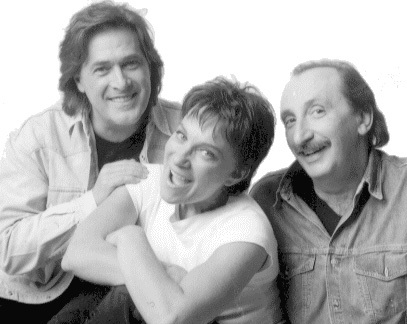
Dominic Grant & Julie Forsyth, two former Guys'n Dolls members, formed a duo in 1985, after the Guys'n Dolls split up. Grant & Forsyth usually sing country songs and are quite popular in the country-scene. On one of their albums they covered Après Toi, the winning song of the Eurovision Song Contest in 1972.
In 1988 they were the backing vocals for Scott Fitzegerald who sang Go which was written by Julie Forsyth.
La Compagnie Créole is a popular French pop band from French Guiana and the French West Indies, who started singing in the 1980s. They originally started singing in Creole but quickly adopted French as their main language. They are best known for the feel-good songs. Popular themes and imagery include colorful rainbows, sunshine, music and harmless animals as a positive morale booster all set to Caribbean rhythms. In 1983 they participated in the French national final with the song Vive Le Douanier Rousseau which came 2nd.
Ricchi E Poveri is an Italian band, founded in 1968 and consists of Franco Gatti, Angela Brambati, Angelo Sotgiu and Marina Occhiena who left the group in 1981. Ricchi E Povery is one the most successful music groups of Italy and are still very popular in Europe, especially in Malta, Italy and Germany. The group participated twelve times at the Festival di Sanremo.
In 1978 Ricchi E Poveri represented Italy at the Eurovision Song Contest in Paris with the song Questo Amore which finished 12th. They had many hits and made lots of successful albums.
Joy Fleming (born Erna Raad on
November 15, 1944 in Rockenhausen, Rhineland-Palatinate, married name
Liebenow) is a German singer who is probably best-known for her
performance in the Eurovision Song Contest in 1975. She performed the
song Ein Lied kann eine Brücke sein and was placed 17th out of 19
countries.
Joy Fleming made a further Eurovision bid in
1986, participating in the German national contest with the song
Miteinander which came 4th. Joy's next involvement with Eurovision came in 2001 when,
under a somewhat confusing arrangement with Swiss television she co-sang
their contribution to the German final. The song, Power of Trust was
performed with two other singers, Lesley Bogaert and Brigitte Oelke and
was placed 2nd. Joy made another attempt in 2002 and finished2nd yet again, this time performing Joy to the World with the
group Jambalaya.
In 1973 Joy represented Germany at the
World Popular Song Festival in Japan with the song Ihr Durft Die Augen
Nicht Verschliessen which came 8th and won an Oustanding Song Award and
an Oustanding Performance Award.
The German national final to select their entry, Vorentscheid 1975: Ein Lied für Stockholm, was held on February 3 at the Hessischer Rundfunk Studio 1 in Frankfurt am Main, and was hosted by journalist Karin Tietze-Ludwig, already well known for hosting the international preview Auftakt für Brighton a year before.
Fifteen songs made it to the national final, which was broadcast by Hessischer Rundfunk to ARD broadcasters across West Germany. The winner was decided by nine regional juries with four members each. Each jury member would assign points 1 to 5 for their five favorite songs. The highest score a song could possibly receive was 180.
The winning entry was Ein Lied kann eine Brücke sein, performed by Joy Fleming and composed by Reiner Pietsch with lyrics by Michael Holm. Other notable competitors included 1971 Contest winner Séverine, two-time German representative Katja Ebstein, German representative Mary Roos, and Peggy March, well known in Germany and briefly in the U.S. for the song I Will Follow Him.
The results:
01. Ein Lied kann eine Brücke sein - Joy Fleming, 134 points
02. Alles geht vorüber - Peggy March, 128 points
03. Eine Liebe ist wie ein Lied - Mary Roos, 115 points
04. Hör wieder Radio - Love Generation, 115 points
05. Ich liebe dich - Katja Ebstein, 110 points
06. Du und ich und zwei Träume - Shuki & Aviva, 108 points
07. Dreh dich im Kreisel der Zeit - Séverine, 97 points
08. Die total verrückte Zeit - Maggie Mae, 97 points
09. Ein Lied zieht hinaus in die Welt - Jürgen Marcus, 90 points
10. Er gehört zu mir - Marianne Rosenberg, 86 points
11. Am Fuß der Leiter - Peter Horton, 79 points
12. San Francisco Symphony - Die Jokers, 57 points
13. Heut' bin ich arm, heut' bin ich reich - Werner W. Becker, 54 points
14. Du - Ricci Hohlt, 38 points
15. Sonja, ich rufe dich - Ricky Gordon, 37 points
In the weeks before the contest Germany was one of the favorites for 1st place but it is said the song was maybe to modern for the contest and the dress which Joy was wearing maybe to tight so the juries ignored her and her song. At the ESC Joy came only 17th.
Ria Hartman-Schildmeyer, better known as Debbie is a Dutch singer who began her singing career as leadsinger of the band Ghizlane. In 1972 Debbie started a solo career and in that same year she had her biggest hit with the song Everybody Join Hands which was for eleven weeks in the Dutch charts. In 1975 Debbie took part in the Dutch national final with the song Circus which got no points at all in the first round. In the second round she sung the winning song Ding A Dong but Debbie came 3rd and last with 11 points. Teach-In won with 56 points and Albert West came 2nd with 33 points. Debbie recorded all the three songs that participate in the Dutch national final of 1975. In 1977 Debbie had a hit with the song Angelino. In the 80's she formed a duo with Oscar Harris and later with Andres but both co-operations were not very successful.
Maksim Mrvica,born May 3, 1975, is a Croatian pianist who plays classic crossover music. Maksim took piano lessons from the age of nine. In 1993 he won his first competition in Zagreb. He studied at the Music Academy in Zagreb, Budapest and Paris. He won several important prizes. He made 8 successful albums which were very successful in Asia. On one of his albums he covered Hrvatska Rapsodija which came 5th in the Croatian national final for the Eurovision Song Contest in 2000.