Sunday, 31 October 2010

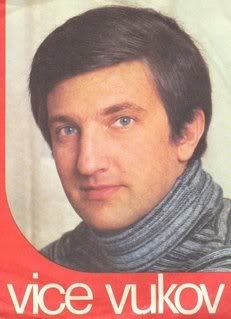
Vice Vukov


Vice Vukov (August 3, 1936, Šibenik - September 24, 2008, Zagreb) was a Croatian singer and politician. During the 1960s, Vice Vukov was one of the most popular singers in Yugoslavia. In 1963 he represented Yugoslavia at the ESC with the song Brodovi which came 11th and in 1965 he represented Yugoslavia again at the ESC, he came 12th with the song Čežnja. In 1969 he participated at the Yugoslav national final with the song Cvijece Za Mariju which came 8th. In 1970 he represented Yugoslavia at the World Popular Song Festival in Japan with the wonderful ballad Neka Cijeli Svijet which won an Outstanding Song Award and an Outstanding Performance Award.

In the aftermath of the Croatian Spring movement, he was branded a Croatian nationalist by Yugoslav authorities and had his apartment searched by the police during the 1972 wave of arrests of Croatian Spring leaders. Vice Vukov was on an Australian tour at that time. His wife warned him not to return because he could be arrested too, so instead he went to live in France, returning to Yugoslavia in 1976. By that time, the authorities had lost interest in his case, but his singing career was effectively over; he was blacklisted, barred from performing publicly and all his records were pulled out of stores.

In 1989 an album of his new songs, without his name on the cover, appeared in Croatian music stores, signalling the political change. Soon after, Vukov made a public comeback with a series of 14 sold-out concerts at Vatroslav Lisinski Concert Hall.

After the introduction of democracy to Croatia, Vice Vukov became a prominent supporter of the Social Democratic Party of Croatia. He ran several times for the seat in Croatian Parliament, finally succeeding in 2003. In 2001 he was suggested as ambassador to Switzerland.

Igor Cukrov

Igor Cukrov born (June 6 1984) is a Croatian singer, musician and television personality. He came to media attention as one of sixteen contestants of the talentshow Operacija trijumf, Balkan version of Endemol's Star Academy. Igor Cukrov represented Croatia in the Eurovision Song Contest 2009 alongside Andrea Šušnjara with the song Lijepa Tena, written by Tonči Huljić. The song qualified to the final from the second semi-final as the jury's selected qualifier. It eventually finished in 18th place with 45 points.

Igor Cukrov performed at the Split Festival where he was awarded a prize for best debutant. Has also gained experience as a tenor of the a Capella Cambi singers.

The Operacija trijumf is the Balkan version of Endemol's talents show Star Academy. It included the young talents from whole former SFR Yugoslavia. The show began on September 29, 2008. Cukrov showcased his singing abilities through a wide repertory, singing opera songs such as Con te partirò of Andrea Bocelli, but also rock songs such as Angie of the Rolling Stones and I Don't Want to Miss a Thing of Aerosmith. The contestants of the Operacija trijumf, including Igor Cukrov, supported Goran Karan at his concert in Belgrade, singing Stand by Me.

Igor Cukrov was expelled on the 13th gala event, losing in telephone voting to Vukašin Brajić. During the show, there were some rumors that the judge Tonči Huljić is very protective about Cukrov, because he was never nominated, until the twelfth gala; Tonči Huljić later stated that expelling Igor Cukrov was an injustice.

After the Operacija trijumf, all the contestants expressed the will to participate at the Eurovision Song Contest 2009. The Croatian OT contestants Cukrov and Ana Bebić immediately qualified for the final event. The song Lijepa Tena was written and composed by famous Croatian musician Tonči Huljić. The Croatian final for the Eurovision Song Contest – Dora – was held on February 28, 2009, and Igor Cukrov won with the total of 30 points. The song competed in the second semi-final where it won qualification for the final as the jury's selected pick. It finished in 18th place.

Interval acts - 1991: Arturo Brachetti


Arturo Brachetti is an Italian quick-change artist. In the Guinness Book of Records 2006 and 2007, he is described as the fastest quick change artist in the world. His career covers a wide artistic range and has made him an international name. The change from one costume to another is performed in a matter of seconds, often by throwing a sheet up and completely changing costume by the time it falls. In the current show, Arturo performs 80 characters in one evening.

In 1991 he performed at the Eurovision Song Contest in Rome during the Interval-act.

Interval acts - 1983: Song Contest ballet with Marlène Charell


In 1983 the interval act was a dance number set to a medley of German songs which had become internationally famous, including Strangers in the Night. The host, Marlene Charell, was the lead dancer.

Marlene Charell (born Angela Miebs on 27 July 1944 in Winsen) is a German entertainer and was the leading dancer and superstar at Le Lido in Paris from 1968 until the end of 1970. Her stage name is an amalgamation of the entertainers Marlene Dietrich and Erik Charell. She also danced at The Dunes casino in Las Vegas in the show Casino de Paris in 1966 and at Folies Bergere from 1962 until 1968. Because of the apparent length and beautiful shape of her legs she was labeled as Miss Longlegs.
In 1983 she hosted the Eurovision Song Contest at the Rudi-Sedlmayer-Halle in Munich. It was rather obvious that Marlene was a dancer and not a presenter…….

Thursday, 28 October 2010

DQ


DQ (born as Peter Andersen in 1973) is a Danish singer and drag queen who won the Danish Melodi Grand Prix 2007 and therefore represented Denmark in the Eurovision Song Contest 2007 with the song Drama Queen. The song was eliminated in the semi-final. In 2011 DQ tried to represent Switzerland t the ESC with the song Take My Heart but the song didn't made it into the Swiss national final.


Wednesday, 27 October 2010

Salomé

Salomé (born June 21, 1943 as born Maria Rosa Marco Poquet in Barcelona, Catalonia, Spain. ), is a female Spanish Catalan singer.

In 1969 she was asked to represent Spain at the Eurovision Song Contest in Madrid. At the Spanish pre-selection all the 10 songs were sung twice, once by Salomé and once by 10 other performers.

At the Eurovision Song Contest held in Madrid in 1969, she performed Vivo Cantando, composed by Maria José Cerato with words by Aniano Alcalde. The song (along with the entries from Netherlands, United Kingdom, and France) shared first place that year.

Salomé recorded Vivo Cantando in 1969 for the Eurovision Song Contest in eight languages (Spanish, Catalan, Basque, French, German, Italian, English, and Serbo-Croat).

Salomé appeared on TVE in May 2006, after the Eurovision Song Contest, to discuss the outcome with 1968 winner, Massiel, and a few other friends.

Tuesday, 26 October 2010

Interval acts - 1970: The Don Lurio Dancers


Donald Benjamin Lurio (Stage name Don Lurio) was born in New York in 1929 although some sources claim that his year of birth was 1933. He died in Rome in 2003. Don Lurio was a dancer, choreographer and conductor for Italian Television. Don Lurio operated a dance studio on Broadway with Bob Fosse and Jack Cole , then toured Europe before arriving in Italy in 1957.
Don was openly gay, considered scandalous given the morals of the time. It took until 1961 to establish himself on Italian Television. He appeared in several Italian films of the 1960s and 1970s. He also appeared in a handful of British films.

In 1970 he choreographed the interval act for the Eurovision Song Contest in Amsterdam for a group of young dancers who called themselves The Don Lurio Dancers. This interval act was considered as very modern in 1970.