Tuesday, 25 September 2012

Eurovision Song Contest 1990

 Eurocat

Date: May 5, 1990
Venue: Vatroslav Lisinski Concert Hall, Zagreb, SR Croatia, Yugoslavia
Presenters: Helga Vlahović Brnobić, Oliver Mlakar
Orchestra: JRT orchestra
Conductor: Igor Kuljerić
Director: Nenad Puhovski
Scruteneer: Frank Naef
Host broadcaster: JRT
Price presenter: Goran Radman
Interval act: Yugoslav Changes – a film about tourism in the country.
Duration: 2 hours, 49 minutes
Number of entries: 22
Debuting countries: -
Returning countries: -
Withdrawing countries: -
Winning Song: Insieme: 1992 - Toto cutugno, Italy
Voting system: Each country awarded 12, 10, 8-1 points to their 10 favourite songs

Toto Cutugno

Entries

01. Spain: Azúcar Moreno - Bandido (5th place, 96 points)
02. Greece: Christos Callow & Wave - Horis skopo (19th place, 11 points)
03. Belgium: Philippe Lafontaine - Macédomienne (12th place, 46 points)
04. Turkey: Kayahan feat. Demet Sağıroğlu - Gözlerinin Hapsindeyim (17th place, 21 points)
05: The Netherlands: Maywood - Ik wil alles met je delen (15th place, 25 points0
06. Luxembourg: Céline Carzo - Quand je te rêve (13th place, 38 points)
07. UK: Emma - Give a little love back to the world (6th place, 87 points)
08. Iceland: Stjórnin - Eitt lag enn (4th place, 124 points)
09. Norway: Ketil Stokkan - Brandenburger Tor (21st place, 8 points)
10. Israel: Rita - Shara barechovot (18th place, 16 points)
11. Denmark: Lonnie Devantier - Hallo Hallo (8th place, 64 points)
12. Switzerland: Egon Egemann - Musik klingt in die Welt hinaus (11th place, 51 points)
13. Germany: Chris Kempers & Daniel Kovac - Frei zu leben (9th place, 60 points)
14. France: Joëlle Ursull - White and black blues (2nd place, 132 points)
15. Yugoslavia: Tajči - Hajde da ludujemo (7th place, 81 points)
16. Portugal: Nucha - Há sempre alguém (20th place, 9 points)
17. Ireland: Liam Reilly - Somewhere in Europe (2nd place, 132 points)
18. Sweden: Edin-Ådahl - Som en vind (16th place, 24 points)
19. Italy: Toto Cutugno - Insieme: 1992 (1st place, 149 points)
20. Austria: Simone - Keine mauers mehr (10th place, 58 points)
21. Cyprus: Haris Anastasiou - Milas Poli (14th place, 36 points)
22. Finland: Beat - Fri (21st place, 8 points)

Maywood

The Eurovision Song Contest 1990, the 35th in the series, was held in Zagreb, Yugoslavia on May 5 1990. The presenters were Helga Vlahović Brnobić and Oliver Mlakar. Toto Cutugno was the winner of this contest with the song Insieme: 1992 which was written by Toto himself. This was the second and most recent victory for Italy, the first one having been Non ho l'età, performed by Gigliola Cinquetti in 1964.

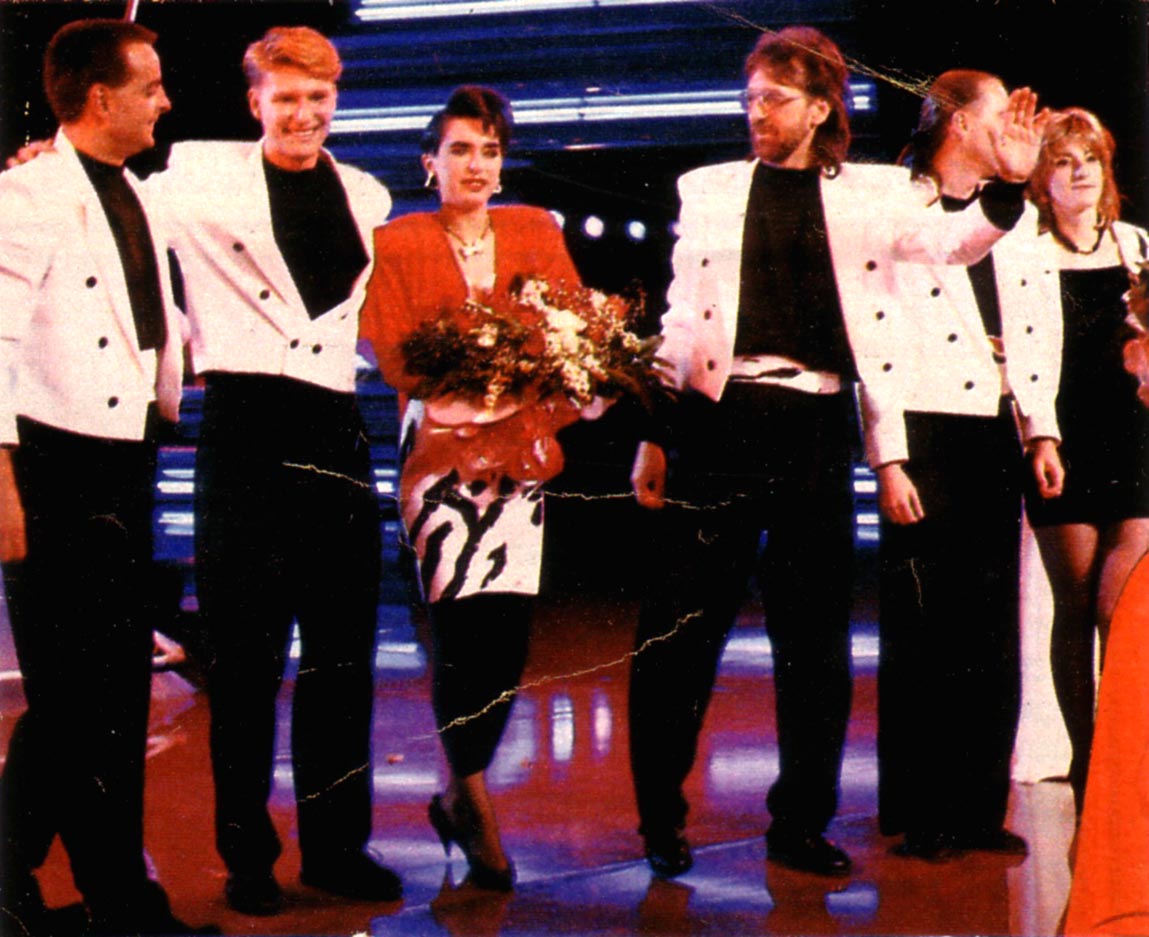
Toto Cutugno sang about bringing the disparate nations of Europe together. The 1992 of the title refers to the year in which the European Union was scheduled to begin operation, thus bringing the hope of the lyric to fruition. Toto sang the song with a backing group of five singers from Slovenia, the group Pepel in Kri, who represented Yugoslavia in 1975.

Helga Vlahović Brnobić & Oliver Mlakar

Format

There was a slightly uncomfortable beginning to the rehearsal week when, offended by press comments concerning their ages (Helga Vlahović Brnobić being 45 at the time and Oliver Mlakar being 54), the two presenters quit the show. They were briefly replaced by Rene Medvešek and Dubravka Marković, who were much younger, but the misunderstandings were eventually allayed and Helga Vlahović Brnobić and Oliver Mlakar returned to the contest.

At the start of the show there was a short film: Zagreb: City of Music.

The lyrics of several entries celebrated the revolution and democratisation that had occurred in central and eastern Europe in the preceding months, focusing especially on the fall of the Berlin Wall in November 1989, such as in the Norwegian and Austrian entries. However, the winning song was an even more sweeping evocation of European unity, in anticipation of the completion of the European single market, due at the end of 1992.

Azúcar Moreno

The Eurovision Song Contest 1990 was the first to implement an age rule. The European Broadcasting Union (EBU) were forced to bring in a restriction rule after criticism arose over the ages of two performers at 1989 contest, being just 11 and 12 years old. From 1990, no artist under the age of 16 on the day of the contest could perform on stage. This rule meant that the record for the youngest ever winner at Eurovision could never be broken, as Sandra Kim, who won for Belgium at the 1986 competition, was just 13 years old.

A notorious mishap occurred at the start of the first song, when a noticeably long delay caused by problems with the backing track was followed by the Spanish singers Azúcar Moreno missing their cue. They walked off the stage in barely concealed annoyance and the audience was left in confusion for a moment, but the song was then restarted without any further problems.

Tajči

From a musicological perspective both Spain's Bandido and France's White and Black Blues can be said to be the first entries to signal a new trend at Eurovision, with both songs fusing contemporary dance music with ethnic influences, from flamenco and calypso respectively. By the 2000s this fusion of ethno/dance/pop had crossed over to mainstream success in the contest, with entries like Turkey's Everyway That I Can, Ukraine's Wild Dances, Greece's My Number One and Norway's Fairytale winning in 2003, 2004, 2005 and 2009.

The 1990 contest was the first to feature an official mascot, called Eurocat, created by Joško Marušić. This mischievous purple cat popped up during the 'postcards' of each of the 22 entries, which also included travelogues of the country about to perform, in conjunction with the European Year of Tourism 1990.

Chris Kempers & Daniel Kovac

Participating countries

Malta had wished to return to the contest for the first time in 15 years, but Eurovision rules prevented them from returning due to a maximum of 22 entries allowed to compete. A national final was held in Malta, which was won by Maryrose Mallia with Our Little World of Yesterday.

Returning artists

Ketil Stokkan, who performed for Norway, represented his country in 1986 with the song Romeo while Haris Anastasiou was a dancer for the Cypriot entry in 1987

Monday, 24 September 2012

Eurovision Song Contest 1989

 Riva

Date: May 6, 1989
Venue: Palais de Beaulieu, Lausanne, Switzerland
Presenters: Jacques Deschenaux, Lolita Morena
Orchestra: Benoit Kaufman orchestra
Conductor: Benoit Kaufman
Director: Alain Bloch, Charles-André Grivet
Scruteneer: Frank Naef
Host broadcaster: SRG/SSR
Price presenter: Céline Dion, Cindy Eschbach
Interval act: Guy Tell, a Wilhelm Tell act.
Duration: 3 hours, 10 minutes
Number of entries: 22
Debuting countries: -
Returning countries: -
Withdrawing countries: Cyprus
Winning Song: Rock me - Riva, Yugoslavia
Voting system: Each country awarded 12, 10, 8-1 points to their 10 favourite songs

Birthe Kjær
Entries

01. Italy: Anna Oxa & Fausto Leali - Avrei voluto (9th place, 56 points)
02. Israel: Gili & Galit - Derekh hamelekh (12th place, 50 points)
03. Ireland: Kiev Conolly & the Missing Passengers - The real me (18th place, 21 points)
04. The Netherlands: Justine Pelmelay - Blijf zoals je bent (15th place, 45 points)
05. Turkey: Pan - Bana bana (21st place, 5 points)
06. Belgium: Ingeborg - Door de wind (19th place, 13 points)
07. UK: Live Report - Why do I always get it wrong (2nd place, 130 points)
08. Norway: Britt Synnøve Johansen - Venners nærhet (17th place, 30 points)
09. Portugal: Da Vinci - Conquistador (16th place, 39 points)
10. Sweden: Tommy Nilsson - En dag (4th place, 110 points)
11. Luxembourg: Park Café - Monsieur (20th place, 8 points)
12. Denmark: Birthe Kjær - Vi maler byen rød (3rd place, 111 points)
13. Austria: Thomas Forstner - Nur ein Lied (5th place, 97 points)
14. Finland: Anneli Saaristo - La dolce vita (7th place, 76 points)
15. France: Nathalie Pâque - J'ai volé la vie (8th place, 60 points)
16. Spain: Nina - Nacida par amar (6th place, 88 points)
17. Cyprus: Fani Polymeri & Yiannis Sawidakis - Apopse as vrethoume (11th place, 51 points)
18. Switzerland: Furbaz - Viver senza tei (13th place, 47 points)
19. Greece: Marianna Efstratiou - To dhiko su asteri (9th place, 56 points)
20. Iceland: Daníel Ágúst Haraldsson - Það sem enginn sér (22nd place, 0 points)
21. Germany: Nino de Angelo - Flieger (14th place, 46 points)
22. Yugoslavia: riva - Rock me (1st place, 137 points)

Justine Pelmelay

The Eurovision Song Contest 1989 was the 34th Eurovision Song Contest and was held on May 6 1989 in Lausanne, Switzerland. Switzerland gained the hosting rights after Celine Dion's victory in Dublin the previous year. The presenters were Lolita Morena and Jacques Deschenaux. Riva was the winner of this Eurovision with the song, Rock Me, representing Yugoslavia. This was the only victory for Yugoslavia as a unified state. Rock me was written by Rajko Dujmić and Stevo Cvikić . The song was performed in Serbo-Croatian, however during the winners' encore lead vocalist Emilija Kokić sang the song in English.

Format

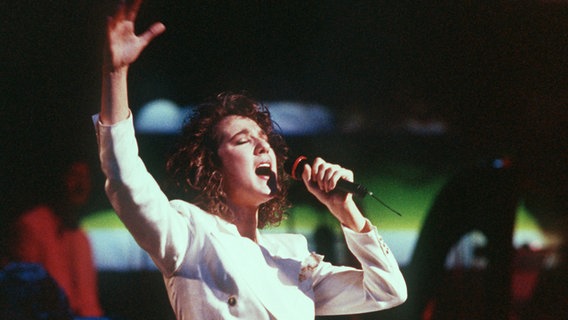
The previous year's winner, Celine Dion, opened the show with a live performance of her winning song and a mimed performance of her first English-language single, Where Does My Heart Beat No". The song went on to become a top ten hit in the US a year later - effectively launching her into international success.

United Kingdom's Ray Caruana, lead singer with Live Report was outspoken about coming second to what he considered a much less worthy song. They had been beaten by 7 points.

Anneli Saaristo

Two of the performers, Nathalie Pâque and Gili Natanael were respectively 11 and 12 years old at their time of competing. Due to bad publicity surrounding their participation, the European Broadcasting Union introduced the rule stating no performer is allowed to take part before the year of their 16th birthday.

Dieter Bohlen was the composer of both the German and the Austrian song.  Both songs were performed without the use of the orchestra by using a backing track. After the show Dieter wasn't pleased at all with the results. The Austrian song came 5th but the German song finished in a very disappointing 14th place.

Lolita Morena, Céline Dion & Jacques Deschenaux

A glitch happened during Guy Tells perfomance during the interval act. The arrow crossbow chain reaction missed the apple scarce that the artist briefly turned away and covered the arrow stuck in the apple. As a slow-motion then the successful attempt of the sample was shown.

Returning artists

This was the first year since 1970 in which no returning artist were present at the contest. Altough Justine Pelmelay was the year before backgroundsinger for Gerard Joling. Søren Bundgaard, member of Hot Eyes (ESC 1984, 1985, 1988), and Henrik Krogsgaard were backroundsingers for Birthe Kjær. Henrik Krogsgaard was also the conducter for the the Danish entry but he gave the baton halfway through the performance to Benoit Kaufman. Marianna Efstratiou, who was the Greek participant, was in a backing vocalist in 1987 for the group Bang.


Sunday, 23 September 2012

Eurovision Song Contest 1988

Céline Dion

Date: April 30, 1988
Venue: RDS Simmonscourt Pavilion, Dublin, Ireland
Presenter: Pat Kenny, Michelle Rocca
Orchestra: RTÉ concert orchestra
Conductor: Noel Kelehan
Director: Declan Lowney
Scruteneer: Frank Naef
Host broadcaster: RTÉ
Price presenter: Johnny Logan
Interval act: Hothouse Flowers performing Don't Go
Duration: 2 hours, 53 minutes
Number of entries: 21
Debuting countries: -
Returning countries: -
Withdrawing countries: Cyprus
Winning Song: Ne partez pas sans moi - Céline Dion, Switzerland
Voting system: Each country awarded 12, 10, 8-1 points to their 10 favourite songs

Entries

01. Iceland: Beathoven - Þú og þeir (Sókrates) (16th place, 20 points)
02. Sweden: Tommy Körberg - Stad i ljus (12th place, 52 points)
03. Finland: Boulevard - Nauravat silmät muistetaan (20th place, 3 points)
04. UK: Scott Fitzgerald - Go (2nd place, 136 points)
05. Turkey: MFÖ - Sufi (15th place, 37 points0
06. Spain: La Década Prodigiosa - La chica que yo quiero (Made in Spain) (11th place, 58 points)
07. The Netherlands: Gerard Joling - Shangri-La (9th place, 70 points)
08. Israel: Yardena Arazi - Ben Adam (7th place, 85 points0
09. Switzerland: Céline Dion - Ne partez pas sans moi (1st place, 137 points)
10. Ireland: Jump The Gun - Take him home (8th place, 79 points)
11. Germany: Maxi & Chris Garden - Lied für einen Freund (14th place, 48 points)
12. Austria: Wilfried - Lisa Mona Lisa (21st place, 0 points)
13. Denmark: Kirsten & Søren - Ka'du se hva'jeg sa'? (3rd place, 92 points)
14. Greece: Afroditi Frida - Clown (17th place, 10 points)
15. Norway: Karoline Krüger - For vår jord (5th place, 88 points)
16. Belgium: Reynaert - Laissez briller le soleil (18th place, 5 points)
17. Luxembourg: Lara Fabian - Croire (4th place, 90 points)
18. Italy: Luca Barbarossa - vivo (12th place, 52 points)
19. France: Gérard Lenorman - Chanteur de charme (10th place, 64 points)
20. Portugal: Dora - Voltarei (18th place, 5 points)
21. Yugoslavia: Srebna Krila - Mangup (6th place, 87 points)

Gerard Joling

The Eurovision Song Contest 1988 was the 33rd Eurovision Song Contest and was held on April 30 1988 in Dublin. The presenters were Pat Kenny and Michelle Rocca. Future international superstar, the French-Canadian Celine Dion, then only famous in the French-speaking world, was the winner of this Eurovision with the song, Ne partez pas sans moi, composed by Swiss-Turkish composer Atilla Şereftuğ with lyrics by Nella Martinetti. This was the second victory for Switzerland. The first one was in 1956: Refrain, performed by Lys Assia. It was also the last time a song in French won the Contest, the language having dominated the event in earlier years.

Format

Radio Telefís Éireann (RTÉ), as the host broadcaster for this edition of the contest, decided that the show's production style needed to be revamped in order to attract and sustain a younger audience. They employed Declan Lowney (who was notable for being a director of music videos and youth programming) as director for this edition, and he would also direct the interval act which included the popular Irish rock group Hothouse Flowers which was filmed in 11 countries around Europe and was the most expensive music video ever produced in Ireland at that time.

At the opening of the show, Johnny Logan sang Hold me now.

The traditional scoreboard was replaced with 2 giant Vidiwalls located on either side of the stage, which also projected live images of the performers from the green room, and a new computer-generated scoreboard was used. The stage itself, conceived by Paula Farrell under chief production designer Michael Grogan, was also the largest and most elaborate ever constructed for a Eurovision. To compensate for the fact that the vast stage took up most of the room in what is really an average size exhibition hall, the Director deliberately darkened the hall where the audience was located and refused to use wide angled shots of the audience, in order to create the illusion of the venue being bigger than it actually was.

Kirsten & Søren

Cyprus was drawn second to compete in Dublin and had selected the song 'Thimame' sung by Yiannis Dimitrou as their entry. However, at a late stage CyBC decided that the song was ineligible to represent them as it had been entered into the 1984 Cypriot selection, where it had finished in 3rd place. This was classed as a breach of the Cypriot rules of selecting their entry at this time (and an infringement of the Eurovision rules) and so Cyprus withdrew from the 1988 contest. It was quite a last-minute decision as the song was advertised in the Radio Times information about the preview programme of the contest. The song also appears on the Norwegian record release of the 1988 Eurovision Song Contest entries.

Voting

The 1988 contest is notable for the quirk of the final votes. With three countries left to vote, the UK were well in the lead with 133 points against Switzerland's 118. With the third last country only awarding Switzerland one point, the UK looked certain of victory, as even if Switzerland scooped the two final 12s, the UK would only need to gather 11 points from three juries combined to be unbeatable. However, that country failed to give the UK any points at all and as the following country gave the UK a meagre three points and the maximum 12 to Switzerland, the contest was suddenly blown open.

Yardena Arazi

With the conclusion of voting from the penultimate jury, the UK was holding a five-point lead over Switzerland. As the final jury, that of Yugoslavia, began to award its points in the customary ascending order, the international audience held its breath to see how the two rivals for victory would fare. Switzerland were the first to be named with six points, barely enough to keep their hopes of winning alive, edging them as it did into a one-point lead. However, given the pattern of voting all evening, it seemed highly likely that the UK would be given one of the higher set of points. But remarkably, after the seven, eight, ten and twelve points were announced, it transpired that Yugoslavia had awarded the UK no points at all, and Switzerland were left to savour a dramatic triumph. After strong votes all night, the UK only managed to garner a mere three points between the last three juries. Yugoslavia had caused the same situation to happen when after their voting UK lost to Spain by 1 point in 1968. The UK entry was written and composed by Julie Forsyth, the daughter of the entertainer Bruce Forsyth who was present. When interviewed afterwards he was particularly annoyed at the Dutch jury not having given a vote to the UK, as they had done some work there.

Returning artists

Six artists returned to the contest this year. Kirsten & Søren represented Denmark in 1984 and 1985 as Hot Eyes, Boulevard reprsented Finland in 1987, Yardena Arazi was one of the presenters of the ESC 1979 and was a member of the Chocolat Menta Mastik who represented Israel in 1976, Dora represented Portugal in 1986, Tommy Körberg represented Sweden in 1969 and the Turkish band MFÖ represented their country in 1985.


Saturday, 22 September 2012

Eurovision Song Contest 1987

 Johnny Logan

Date: May 9, 1987
Venue: Palais du Centenaire, Brussels, Belgium
Presenter: Viktor Lazlo
Orchestra: Jo Carlier Orchestra
Conductor: Jo Carlier
Director: Jacques Bourton
Scruteneer: Frank Naef
Host broadcaster: RTBF
Price presenter: Sandra Kim
Interval act: Mark Grauwels
Duration: 2 hours, 58 minutes
Number of entries: 22
Debuting countries: -
Returning countries: Greece, Italy
Withdrawing countries: -
Winning Song: Hold Me Now - Johnny Logan, Ireland
Voting system: Each country awarded 12, 10, 8-1 points to their 10 favourite songs

Entries

01. Norway: Kate Gulbrandsen - Mitt liv (9th place, 65 points)
02. Israel: Datner & Kushnir - Shir habatlanim (8th place, 73 points)
03. Austria: Gary Lux - Nur noch Gefühl (20th place, 8 points)
04. Iceland: Halla Margrét - Hægt og hljótt (16th place, 28 points)
05. Belgium: Liliane Saint-Pierre - Soldiers of love (11th place, 56 points)
06. Sweden: Lotta Engberg - Boogaloo (12th place, 50 points)
07. Italy: Umberto Tozzi & Raf - Gente di mare (3rd place, 103 points)
08. Portugal: Nevada - Neste barco à vela (18th place, 15 points)
09. Spain: Patricia Kraus - No estás solo (19th place, 10 points)
10. Turkey: Seyyal Taner & Lokomotif - Şarkım sevgi üstüne (22nd place, 0 points)
11. Greece: Bang - Stop (10th place, 64 points)
12. The Netherlands: Marcha - Rechtop in de wind (5th place, 83 points)
13. Luxembourg: Plastic Bertrand - Amour, amour (21st place, 4 points)
14. UK: Rikki - Only the light (13th place, 47 points)
15. France: Christine Minier - Les mots d'amour n'ont pas de dimanche (14th place, 44 points)
16. Germany: Wind - Laß die Sonne in dein Herz (2nd place, 141 points)
17. Cyprus: Alexia - Aspro mavro (7th place, 80 points)
18. Finland: Vicky Rosti & Boulevard - Sata salamaa (15th place, 32 points)
19. Denmark: Anne-Catherine Herdorf & Bandjo - En lille melodi (5th place, 83 points)
20. Ireland: Johnny Logan - Hold me now (1st place, 172 points)
21. Yugoslavia: Novi Fosili - Ja sam za ples (4th placem 92 points)
22. Switzerland: Carol Rich - Moitié, moitié (17th place, 26 points)

Marcha

The Eurovision Song Contest 1987 was the 32nd Eurovision Song Contest and was held on May 9 1987 in Brussels, Belgium after Sandra Kim's win the previous year. The presenter was Viktor Lazlo. Johnny Logan was the winner for Ireland with his selfcomposed song Hold Me Now. That made him the first performer to win the contest twice, as he had won also in 1980.

Format

At the opening Viktor Lazlo sang the song Breathless. The 1987 Eurovision was the biggest contest at that time, with 22 countries taking part. Only Malta, Monaco and Morocco failed to compete out of all the countries which had entered the contest in the past. Due to the number of countries, and the time it took for the contest to be held, the EBU set the limit of competing countries to 22. This became problematic over the next few years as new and returning nations indicated an interest in participating, but could not be accommodated.

Controversy erupted in Israel after their song was selected, Shir Habatlanim by Datner & Kushnir. The comedic performance was criticised by the country's culture minister, who threatened to resign should the duo proceed to Brussels. They went on to perform for Israel, placing eighth; however the culture minister's threat was left unfulfilled.

It was the last time that there would be a physical prop for the scoreboard. All subsequent editions featured computerised graphics.

Umberto Tozzi & Raf

The United Kingdom achieved their lowest placing to date, when Rikki finished in 13th place with the song Only The Light.

Returning artists

Four artists returned to the contest this year. Gary Lux performed for Austria in 1983, 1984 and 1985, Alexia was a member of Island, who represented Cyprus in 1981,  Wind represented Germany in 1985 and Johnny Logan won the ESC in 1980 on behalf of Ireland.

Possible Sovjet Union participation

In 2009 Eduard Fomin, a former employee of the Ministry of Education of the RSFSR, revealed that in 1987 George Veselov, the Minister of Education for the Soviet Union, brought forward the idea of a participation of the Soviet Union at the Eurovision Song Contest due to the number of political reforms made by the President of the Soviet Union Mikhail Gorbachev during the late 1980s. The idea was mainly a political one, with the thought that a win in the contest for the Soviet Union would impact on the relationships between the Soviet Union and the capitalist countries of the west. Valery Leontyev was suggested as a name for the Soviet Union's first participation, however Veselov's ideas were not shared by the Communist Party of the Soviet Union, or by Gorbachev himself, believing it to be too radical a step to take, and so no Soviet participation was ever made. Ten former republics of the Soviet Union would later compete in the contest on their own in the 1990s and 2000s: Russia, Estonia, Lithuania, Latvia, Ukraine, Belarus, Moldova, Armenia, Georgia, and Azerbaijan, with five of the countries going on to win the contest.


Wednesday, 19 September 2012

Eurovision Song Contest 1986

Sandra Kim

Date: May 3, 1986
Venue: Grieghallen, Bergen, Norway
Presenter: Åse Kleveland
Orchestra: NRK orchestra, Kringkastingsorkesteret
Conductor: Egil Monn-Iversen
Director: John Andreassen
Scruteneer: Frank Naef
Host broadcaster: NRK
Price presenter: Bobbysocks, Rolf Løvland
Interval act: Sissel Kyrkjebø and Steinar Ofsdal
Duration: 2 hours, 43 minutes
Number of entries: 20
Debuting countries: Iceland
Returning countries: Netherlands, Yugoslavia
Withdrawing countries: Greece, Italy
Winning Song: J'aime la vie - Sandra Kim, Belgium
Voting system: Each country awarded 12, 10, 8-1 points to their 10 favourite songs

Entries

01. Luxembourg: Shrisse Laurence - L'amour de ma vie (3rd place, 117 points)
02. Yugoslavia: Doris Dragović - Željo moja (11th place, 49 points)
03. France: Cocktail Chic - Européennes (17th place, 13 points)
04. Norway: Ketil Stokkan - Romeo (12th place, 44 points)
05. UK: Ryder - Runner in the night (7th place, 72 points)
06. Iceland: ICY - Gleðibankinn (16th place, 19 points)
07. The Netherlands: Frizzle Sizzle - Alles heeft ritme (13th place, 40 points)
08. Turkey: Klips ve Onlar - Halley (9th place, 53 points)
09. Spain: Cadillac - Valentino (10th place, 51 points)
10. Switzerland: Daniela Simmons - Pas pour moi (2nd place, 140 points)
11. Israel: Moti Giladi & Sarai Tzuriel - Yavo yom (19th place, 7 points)
12. Ireland: Luv Bug - You can count on me (4th place, 96 points)
13. Belgium: Sandra Kim - J'aime la vie (1st place, 176 points)
14. Germany: Ingrid Peters - Über die Brücke geh'n (8th place, 62 points)
15. Cyprus: Elpida - Tora zo (20th place, 3 points)
16. Austria: Timna Brauer - Die Zeit ist einsam (18th place, 12 points)
17. Sweden: Lasse Holm & Monica Törnell - E' de' det här du kallar kärlek? (5th place, 78 points)
18. Denmark: Lise Haavik - Du er fuld af løgn (6th place, 77 points)
19. Finland: Kari Kuivalainen - Never the end (15th place, 22 points)
20. Portugal: Dora - Não sejas mau p'ra mim (14th place, 28 points)

Frizzle sizzle

Backround

By 1985, Norway had received the unwanted distinction of being the nul points country, receiving 0 points three times and coming in last six times. When they did win the 1985 Contest, it was a source of pride among Norwegian population, and the national broadcaster, NRK, took full advantage of being able to showcase Norway and its achievements in front of over 500 million television viewers. By the autumn of 1985, NRK had decided to hold the next year's contest at the Grieghallen in Bergen, turning down other bids from capital Oslo, and main cities of Stavanger, Sandnes and Trondheim.

Format

The Eurovision Song Contest 1986 was the 31st Eurovision Song Contest and was held on May 3, 1986 in the Grieg Hall in Bergen, Norway. It was the first occasion on which Norway played host to the contest. The presenter was Åse Kleveland, a well-known folk guitarist who was President of the Norwegian Association of Musicians and a former Eurovision entrant, in 1966.

The 1986 contest was a first for Eurovision in that royalty were among the guests—Crown Prince Harald, Crown Princess Sonja, Princess Märtha Louise and Prince Haakon Magnus were all in attendance.

As this was the first time Norway hosted a Eurovision Song Contest, NRK commissioned a lavish budget for the event, turning Grieghallen into a Viking-esque ice palace for the live show, complete with white and pastel neon lights for the stage. In addition, NRK also had a special diamond-encrusted dress made for presenter Åse Kleveland for her opening number. The prized dress, which weighed upwards of 15 pounds (6.8 kg), is still available for viewing at NRK's costuming department at Marienlyst in Oslo.

Sherisse Laurence

Åse Kleveland sang the multilingual song Welcome to Music as the opening act, incorporating English and French primarily, in addition to other European languages. BBC commentator Terry Wogan, at the close of Kleveland's number, dryly remarked, Katie Boyle never sang, did she?

During her opening speech, Åse Kleveland said of Norway's road in the contest, For those of you who have followed Norway's course through the history of the Eurovision Song Contest, you will know that it has been quite thorny, in fact. So, imagine our joy when last year we finally won, and the pleasure we feel today, being able to welcome 700 million viewers to the top of Europe, to Norway, and to Bergen.

The interval act featured Norwegian musicians Sissel Kyrkjebø and Steinar Ofsdal, accompanied by Norwegian national broadcasting orchestra, Kringkastingsorkesteret. They opened with the traditional song of the city of Bergen, Udsikter fra Ulriken, and presented a number of familiar tunes while showing the sights and sounds of Bergen area. Ofsdal played a range of traditional Norwegian folk instruments such as accordion, recorder and hardingfele. The presentation launched Kyrkjebø into a career as an internationally recognized artist.

The winner

Sandra Kim was the winner of this Eurovision with the song, J'aime la vie which was written by R. Marino-Atria and J.F. Furnemont-A. Crisci. Aged 13, Sandra Kim was the youngest ever Eurovision winner. Current rules require Eurovision Song Contest participants to be at least 16, so unless the rule is changed Sandra Kim's record will never be broken. In the lyrics of her song, Sandra claimed to be 15 years of age, but after the contest, it was revealed that she was actually 13. Switzerland, who finished second, appealed for her to be disqualified, but this was to no avail.

Ingrid Peters

Voting

The winning song, Belgium's J'aime la vie, received points from every jury (Belgium received five sets of 12 points; every country awarded Belgium at least five points except for Germany, which gave them just one point). Belgium was the winner in the voting from the results of the second jury out of twenty, in the longest winning stretch during voting since 1974.

Switzerland was behind Belgium in nearly every part of the voting, but Belgium had a commanding lead from the very beginning.

Traditionally some juries give high points to the host country's entrant, but this did not happen this year; no jury gave Norway's song Romeo more than six points out of a possible 12.

Participating countries

Iceland competed for the first time, as the national broadcaster RÚV finally cemented their satellite television connections with the rest of Europe.

Greece withdrew, having been drawn eighteenth in order of presentation. The reason behind the withdrawal, was that the Eurovision contest coincided with Holy Saturday. Their entry would have been Wagon-lit performed by Polina. The Italian broadcaster, RAI, simply decided not to send any delegation to Bergen.

Returning artists

Elpida, who represented Greece in 1979, represented Cypus with the song Tora zo which came last.


Tuesday, 18 September 2012

Eurovision Song Contest 1985

Bobbysocks!

Date: May 4, 1985
Venue: Scandinavium, Gothenburg, Sweden
Presenter: Lill Lindfors
Conductor: Curt-Eric Holmquist
Director: Steen Priwin
Scruteneer: Frank Naef
Host broadcaster: SVT
Price presenter: Herreys
Interval act: Guitars Unlimited with Swedish Evergreens
Duration: 2 hours, 45 minutes
Number of entries: 19
Debuting countries: -
Returning countries: Greece, Israel
Withdrawing countries: Netherlands, Yugoslavia
Winning Song: La det swinge - Bobbysocks!, Norway
Voting system: Each country awarded 12, 10, 8-1 points to their 10 favourite songs

Entries

01. Maria Christian - Wait until the weekend comes (6th place, 91 points)
02. Finland: Sonja Lumme - Eläköön elämä (9th place, 58 points)
03. Cyprus: Lia Vissi - To katalava arga (16th place, 15 points)
04. Denmark: Hot Eyes - Sku' du spørg' fra no'en? (11th place, 41 points)
05. Spain: Paloma San Basilio - La fiesta terminó (14th place, 36 points)
06. France: Roger Bens - Femme dans ses rêves aussi (10th place, 56 points)
07. Turkey: MFÖ - Didai didai dai (14th place, 36 points)
08. Belgium: Linda Lepomme - Laat me nu gaan (19th place, 7 points)
09. Portugal: Adelaide - Penso em ti, eu sei (18th place, 9 points)
10. Germany: Wind - Für alle (2nd place, 105 points)
11. Israel: Izhar Cohen - Olé, Olé (5th place, 93 points)
12. Italy: Al Bano & Romina Power (7th place, 78 points)
13. Norway: Bobbysocks! - La det swinge (1st place, 123 points)
14. UK: Vikki - Love is (4th place, 100 points)
15. Switzerland: Mariella Farré & Pino Gasparini - Piano, piano (12th place, 39 points)
16. Sweden: Kikki Danielsson - Bra vibrationer (3rd place, 103 points)
17. Austria: Gary Lux - Kinder dieser welt (8th place, 60 points)
18. Luxembourg: Margo, Franck Olivier, Diane Solomon, Ireen Sheer, Chris & Malcolm Roberts - Children, Kinder, Enfants (13th place, 37 points)
19. Greece: Takis Biniaris - Miazzoume (16th place, 15 points

Linda Lepomme

The Eurovision Song Contest 1985 was the 30th Eurovision Song Contest and was held on May 4 1985 in Gothenburg, Sweden. The presenter was Lill Lindfors, and Norwegian duo Bobbysocks! was the winner of this Eurovision with the song La det swinge which was written by Rolf Løvland. Lill Lindfors opened the show by singing the song My joy is building bricks of music.

Voting

During the exciting voting, it was not immediately evident that Norway would win the Contest. Germany took a commanding lead in the first half, with Norway fifth place behind Germany, Sweden, Italy and the United Kingdom around the end of the first half of voting. Finally, with five juries left, Germany, Sweden and Norway were tightly wrapped around the pole positions with 87, 86, and 85 points respectively.

Takis Biniaris

At that point, Sweden briefly took the lead away from Germany (who received no points from Switzerland). Sweden was the fourth-to-last jury, conceding their brief lead by awarding Germany eight points and Norway the full twelve. With only three countries left to vote, Norway kept the lead, in one of the shortest winning stretches during voting in the Contest's history.

It is interesting to note that Norway scored the maximum 12 points from eight countries, just one short of Germany's record of nine in 1982. However, the Norwegian duo scored a total of just 27 points from the other ten juries (with no country awarding them 8 or 10 points). The winning score of 123 points is the lowest since the current scoring system was implemented in 1975. However, the winning score was broken at the Junior Eurovision Song Contest 2009 with a Netherlands win with 121 points and broken again in the Junior Eurovision Song Contest 2010 with a Armenia win with 120 points. With increasing number of participating nations it is very unlikely to win any future Eurovision Song Contest with lower result.

Paloma San Basilio

The winner

La det swinge is a tribute to dancing to old rock 'n' roll heard on the radio. Befitting the subject matter, the song itself is written in an old-fashioned style, with a memorable saxophone melody setting the chorus off. The melody arrangement is in retro style, containing elements of contemporary 1980s music and throwbacks to the 1950s.

The song was performed thirteenth on the night and at the close of voting, it received 123 points, placing 1st in a field of 19.

For their Eurovision appearance, the two members - Hanne Krogh and Elisabeth Andreasson - appeared in sparkling, bright purple jackets, worn over black and white outfits; Hanne Krogh sported a striking, black-and-white striped floor-length gown.
Kikki Danielsson

Following their win, the single La det swinge peaked at #1 in the Norwegian and Belgian singles chart, and entered the charts in Denmark, Sweden, Switzerland, Austria, Ireland, United Kingdom to name a few.

Bobbysocks!' win for Norway was the country's first. Host Lill Lindfors, upon Norway's win, congratulated Hanne Krogh and Elisabeth Andreassen of Bobbysocks! by saying, I must say I am honestly very happy that this happened because Norway has been last on so many times that you really deserve it! Krogh replied, You're happy? What do you think we are?! After an energetic reprise, the two women embraced to a standing ovation from the audience.

Participating countries

The Netherlands and Yugoslavia did not participate in this Contest, due to the national Remembrance of the Dead in the Netherlands, and the anniversary of the death of Josip Broz Tito in Yugoslavia.The song from Spain was the big favourite for the juries but finally came 14 in a field of 19.

 Gary Lux

Returning artists

Also is this year known to be the year in the History of the Eurovision Song Contest, where most of artists, 13 at all, made a comeback. This also applied to the winners, Bobbysocks! who had attended once before alone, Hanne Krogh as solo performer for Norway in 1971, Elisabeth Andreassen for her second country, Sweden, in 1982, in a duet with Kikki Danielsson, which this year also made a comeback, for Sweden, and was thus competing with Elisabeth Andreassen & Bobbysocks!.

other returning artists
  • Gary Lux: Austria 1983, as a member of Westend and Austria 1984, as a backing vocalist for Anita
  • Lia Vissi: Greece 1980, as a member of the Epikouri
  • Hot eyes: Denmark 1984
  • Izhar Cohen: Israel 1978 
  • Al Bano & Romina Power: Italy 1976
  • Ireen Sheer: Luxembourg 1974 and Germany 1978
  • Kikki Danielsson: Sweden 1982, as a member of Chips
  • Pino Gasparini: Switzerland 1977, as a member of Pepe Lienhard Band
  • Mariella Farré: Switzerland 1983
Roger Bens

Notable facts

Lill Lindfors had a wardrobe malfunction (though technically, this is a misnomer, as the stunt was deliberate) as she was walking onstage for the voting session. As she walked on stage, her skirt fell off, leaving her with just her underpants on below. After a few moments of pretending to be shocked, Lill Lindfors removed the parts of her dress hidden inside itself, so that the full dress was visible afterwards.

This was Norway's first victory, since first participating in the contest since 1960, and coming in last place at the 1963, 1969, 1974, 1976, 1978 and 1981 contests. The presenter Lill Lindfors commented with Norway has come last so many times, so I really think you deserve this.

The original choice of Belgian entry was Vannacht performed by Mireille Capelle. A dispute concerning the lyric of the song was responsible for its withdrawal.

UK backing vocals were provided by Sue and Sunny. They had previously done the same job for Lulu in 1969 and Joy Fleming in 1975.


Sunday, 16 September 2012

Eurovision Song Contest 1984

Herreys

Date: May 5, 1984
Venue: Grand Theatre, Luxembourg
Presenter: Désirée Nosbusch
Orchestra: Pierre Cao orchestra
Conductor: Pierre Cao
Director: René Steichen
Scruteneer: Frank Naef
Host broadcaster: RTL
Price presenter: Corinne Hermès
Interval act: Prague Theatre of Illuminated Drawings
Duration: 2 hours, 13 minutes
Number of entries: 19
Debuting countries: -
Returning countries: Ireland
Withdrawing countries: Greece, Israel
Winning Song: Diggi-Loo Diggi-Ley - Herreys, Sweden
Voting system: Each country awarded 12, 10, 8-1 points to their 10 favourite songs

Entries


01. Sweden: Herreys - Diggi-Loo Diggi Ley (1st place, 145 points)
02. Luxembourg: Sophie Carle - 100% d'amour (10 place, 39 points)
03. France: Annick Thoumazeau - Autant d'amoureux que d'étoiles (8th place, 61 points)
04. Spain: Bravo - Lady, lady (3rd place, 106 points)
05. Norway: Dollie de Luxe - Lenge leve livet (17th place, 29 points)
06. UK: Belle & the Devotions - Love games (7th place, 63 points)
07. Cyprus: Andy Paul - Anna Mari-Elena (15th place, 31 points)
08. Belgium: Jacques Zegers - avanti la vie (5th place, 70 points)
09. Ireland: Linda Martin - Terminal 3 (2nd place, 137 points)
10. Denmark: Hot Eyes - Det'lige det (4th place, 101 points)
11. The Netherlands: Maribelle - Ik hou van jou (13th place, 34 points)
12. Yugoslavia: Vlado & Isolda - Ciao, amore (18th place, 28 points)
13. Austria: Anita - Einfach weg (19th place, 5 points)
14. Germany: Mary Roos - Aufrecht geh'n (13th place, 34 points)
15. Turkey: Beş Yıl Önce, On Yıl Sonra - Halay (12th place, 37 points)
16. Finland: Kirka - Hengaillaan (9th place, 46 points)
17. Switzerland: Rainy Day - Welche Farbe hat der Sonnenschein (16 th place, 30 points0
18. Italy: Alice & Franco Battiato - I treni di Tozeur (5th place, 70 points)
19. Portugal: Maria Guinot - Silêncio e tanta gente (11th place, 38 points)

Mary Roos

The Eurovision Song Contest 1984 was the 29th Eurovision Song Contest and was held on 5 May 1984 in Luxembourg.

Format

In an introductory video at the start of the show, Pierre Cao and the RTL orchestra performed instrumental versions of all the past Eurovision winners from Luxembourg.

The presenter was Désirée Nosbusch. Nosbusch, only 19 years old at the time, hosted the show in a lax manner, which was quite unusual for this show back then. She manifested her fluency in four languages when she switched between English, French, German and Luxembourgish in the course of her speech, often in the same sentence.

Maribelle

The Herreys were the winners of this Eurovision with the song, Diggi-Loo Diggi-Ley. Their "golden shoes" have become a pop-cult classic since their win in 1984. The win was Sweden's second, and the first for a song performed in Swedish. The previous Swedish winner, Waterloo by ABBA in 1974, had been performed in English. Diggi-Loo Diggi-Ley was written by Torgny Söderberg and Britt Lindeborg.

The song Diggi-Loo Diggi-Ley is a perfect illustration of the time period in which it was performed; a very upbeat 1980s-style dance song, performed by three impossibly clean cut young men. Fellow Swedish Eurovision participant Tommy Körberg famously dubbed them the dancing deodorants in the press, a derogatory nickname that stuck with them for the rest of their career in their home country. The nonsensical title harking back to previous entries such as Boom Bang-a-Bang, Ding-A-Dong and La La La. The song has achieved considerable fame among Eurovision Song Contest fans, with a well-known archive of Contest lyrics using the domain name diggiloo.net, named after it. Despite the reception the song receives today, in the run-up to the Contest it was not an immediate favorite to win; bookmakers Ladbrokes had Ireland's "Terminal 3" and Italy's "I treni di Tozeur" as higher favourites, so the song winning came as a surprise to many.

According to author John Kennedy O'Connor's The Eurovision Song Contest - The Official History, The Herrey's opened the contest and thus became the third winners of the competition to sing from pole position, following Teach-In in 1975 and Brotherhood of Man in 1976. No song sung first has won since.

 Linda Martin

Participating countries

Israel withdrew from the contest due to a local memorial day commemorated on the same date. This year is also notable as one of the first contests where audible booing for an entry could be heard from the audience which occurred at the end of the UK's performance. It was said that the booing was due to English football fans causing damage in Luxembourg the year prior to the contest. However, the song itself managed a pretty good showing and reached 7th place.

Belle & the Devotions

Voting

Each country had a jury that awarded 12, 10, 8, 7, 6, 5, 4, 3, 2, 1 points for their top ten songs.

At the close of the penultimate jury's votes, there was only a difference of six points between Sweden and Ireland (141 and 135 respectively). However, Yugoslavia was the only country who had not given any points to Ireland and the last jury, Portugal, gave Ireland only 2 points, thus crushing their chances of winning. Portugal's voting also cost Denmark, who had been lying on a very strong 3rd position, and even leading the score board for a short time, its 3rd place, when Portugal's 12 lifted Spain from 94 to 106 points, while Portugal at the same time had only given Denmark one point making Denmark's total 101 points. Despite this, this was Denmark's best position in over 20 years.

Halfway through the voting, the scoreboard turned blue and remained blue until the end of the voting. Only television viewers could see the blue scoreboard

Returning artists

Three artists returned to the contest this year. Mary Roos represented Germany in 1972 and Izolda Barudžija was in 1982 member of the Yugoslav entry Aska and in 1983 she was a backing vocalist for Danijel, who performed for Yugoslavia.