Date: November 15 2003
Venue: Forum Copenhagen, Copenhagen, Denmark
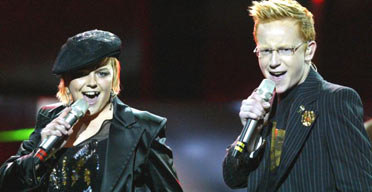
Presenters: Camilla Ottensen, Remee
Host broadcaster: DR
Interval act: Sugababes performing Hole in the Head,Busted performing Crashed the Wedding
Number of entries: 16
Voting system: Each country awards 1-8, 10, and 12 points to their 10 favourite songs
Winner: Ti Si Moja Prva Ljubav - Dino Jelusić, Croatia
Dino Jelusić
Entries
01. Greece: Nicolas Ganopoulos - Filoi gia panta (8th place, 53 points)
02. Croatia: Dino Jelusić - Ti si moja prva ljubav (1st place, 134 points)
03. Cyprus: Theodora Rafti - Mia efhi (14th place, 16 points)
04. Belarus: Volha Satsiuk - Tantsui (4th place, 103 points)
05. Latvia: Dzintars Čīča - Tu esi vasarā (9th place, 37 points)
06. F.Y.R. Macedonia: Marija & Viktorija - Ti ne me poznavaš (12th place, 19 points)
07. Poland: Kasia Żurawik - Coś mnie nosi (16th place, 3 points)
08. Norway: 2U - Sinnsykt gal forelsket (13th place, 18 points)
09. Spain: Sergio - Desde el cielo (2nd place, 125 points)
10. Romania: BUBU - Tobele sunt viaţa mea (10th place, 35 points)
11. Belgium: X!NK - De vriendschapsband (6th place, 83 points)
12. UK: Tom Morley - My song for the world (3rd place, 118 points)
13. Denmark: Anne Gadegaard - Arabiens drøm (5th place, 93 points)
14. Sweden: The Honeypies - Stoppa mig (15th place, 12 points)
15. Malta: Sarah Harrison - Like a star (7th place, 56 points)
16. The Netherlands: Roel - Mijn ogen zeggen alles (11th place, 23 points)
Roel
Format
The Junior Eurovision Song Contest 2003 was the first Eurovision Song Contest for young singers aged eight to fifteen. It was held on November 15 2003, in Copenhagen, Denmark. With Camilla Ottesen and Remee as the presenters, the contest was won by the then eleven-year-old Dino Jelusić, who represented Croatia with his song Ti Si Moja Prva Ljubav while second and third place went to Spain and the United Kingdom respectively.
It was the first Eurovision to be broadcast in the 16:9 widescreen format. It was also the first Eurovision Song Contest where a DVD of the contest would be released. It was decided that the country that won the contest would not necessarily host the next contest, in order to reduce the pressure on the contestants.
Tom Morley
Slovakian broadcaster Slovenská televízia (STV) and German broadcaster ARD expressed an interest in joining this contest and were included in a draw for the chance of participating in the programme (though the results of this draw later became redundant).
Interval acts
The half time entertainment was provided by two acts from the UK. Busted performed Crashed the Wedding but Charlie Simpson was absent due to illness. However, the following day he was present for a radio interview in the UK where it was implied by both himself, and the other band members, that this was in fact a lie. The real reason for his absence was that he hated Eurovision. The Sugababes performed Hole in the Head.
Mitt Mod is a song about courage. The singer discribes her anxiety to do all kinds of stuff but with a lot of courage the singer feels confident to do the things she wants to do.
Lova Sönnerbo (14) has been singing since she was 3 years old. She composes her own songs since she was 6 - 7 years old.
Lova studies today at music school Kulturama in Stockholm. In addition to piano, she plays guitar and just started playing the drums.
Besides music, Lova loves movies, fashion, football, swimming, cooking and baking. She also likes to travel and hike in Norway. She wants to continue to invest in music and will do everything to fulfull that dream.
Më Merr Në Ëndërr was the Albanian entry to the Eurovision Song Contest 2009, held in Moscow, Russia. The song was composed by Edmond Zhulali and Agim Doçi. At the ESC the song was performed in English by Albanian singer Kejsi Tola as Carry Me In Your Dreams.
The song was the winner of Festivali I Këngës 47, the festival used to select Albania's Eurovision entry. Albania was the first country to select and publicly present its song. The song was chosen as the winner of the festival on 21st December 2008, five months before Eurovision, to be held on 16th May 2009. The song was performed during Festivali I Këngës in Albanian as Më merr në ëndërr (Take me into your dreams), and the English version of the song, Carry me in your dreams was premiered on 18 March.
Kejsi performed the song at the Eurovision Song Contest 2009 semi-final on May 14 2009, performing 16th in the running order. She received 73 points, placing 7th of the 19 competing songs, and qualifying to the final.
At the final on 16 May Kejsi Tola performed 19th in the running order. The song received 48 points, placing 17th of the 25 competing songs.
The staging featured two b-boys dressed as mimes (twin brothers) and a sequined green man (Jenia Evgenios Buli, who has performed with Kalomira in 2008 and Giorgos Alkaios in 2010). If only tele-voting had been used, Albania would have come in 11th.
***
Kejsi Tola (February 5 1992, Tirana) is an Albanian singer and the winner of Albanian Idol 2007. In 2008 she was the winning contestant in the Festivali i Këngës competition to find the representative for Albania in the Eurovision Song Contest 2009 in Moscow, Russia.
Her career started when she was 11 years old in the Young Voices of Albania Festival where she won the first prize. Kejsi was also a two time winner of the young voices of the Shkodra Festival.
In the first Contest of Young Geniuses she was one of the ten finalists. In 2008 she won the Best New Artist prize in the Friday Fever Song Contest of Albanian modern music, and in 2008 she won Festivali i Këngës with the song Më merr në ëndërr.
Kejsi Tola attempted to enter the Eurovision Song Contest again in 2010, for the second consecutive time, by participating in Festivali i Këngës 2009 on 27 December 2009. But she placed just 15th with her ballad Ndonjëherë.
Kejsi tried once more to represent Albania for the Eurovision Song Contest 2011 in Düsseldorf, Germany. However, her mid-tempo song Pranë did not go through the second semi-final during the selection process.
A More-More is about a bright and clear sea and happy kids under the sun. Egor Zheshko sings that life is cool and amazing.
Egor Zheshko (12) was born in Minsk on Christmas Eve 1999. He became a talented musician at a very young age. Following his mom, he gladly sang lullabies and folk songs, but when he was asked to perform a children's song in public, he refused: singing is not a man's job. His interests at the time were building combat units of soldiers, collect toy guns and sail pirate ships.
After a recommendation by his teacher Egor finally joined a pop-vocal studio, organized by the art group "Belarusians" in the music production center "Golden Voice." Last year he was one step from victory at the national selection for the Junior Eurovision Song Contest, where he was praised for his talent and led him to a lot of competitions and concerts.
Friendly and open, Egor likes computer, chess and checkers, playing the piano and reading books. His favourite artists are Luciano Pavarotti, Joe Dassin and Patricia Kaas. He dreams of becoming a professional singer.
Semi-final date: May 19, 2005
Final date: May 21th, 2005
Venue: Palace of Sports,Kiev, Ukraine
Presenters: Maria Efrosinina, Pavlo Shylko
Director: Sven Stojanovic
Scruteneer: Svante Stockselius
Host broadcaster: NTU
Opening act Semi-final: Ukranian artists
Opening act final: Ruslana
Interval act Semi-final: Irina Mazur
Interval act Final: Ruslana
Duration Semi-final: 2 hours, 18 minutes
Duration Final: 3 hours, 26 minutes
Number of entries: 39
Debuting countries: Bulgaria, Moldova
Returning countries: Hungary
Withdrawing countries: -
Winning Song: My number one - Helena Paparizou, Greece
Voting system: Each country awarded 12, 10, 8-1 points to their 10 favourite songs
The Eurovision Song Contest 2005 was the 50th Eurovision Song Contest, which was held at the Palace of Sports, Kiev, Ukraine. The winner was Greece's My Number One, written by Greek singer-songwriters Christos Dantis and Natalia Germanou and performed by Swedish-born Greek singer Elena Paparizou, who scored 230 points, while Malta's Angel written and performed by Chiara was the runner up with 192 points and the 3rd place went to Romania's Let Me Try. The contest took place on 19 May for the semifinal and 21 May 2005 for the final. Organizers hoped that this event would boost Ukraine's image abroad and increase tourism, while the country's new government hoped that it would also give a modest boost to the long-term goal of acquiring European Union membership.
Overwiew
The official logo of the contest remained the same from the 2004 contest with the country's flag in the heart being changed. Following Istanbul's 'Under The Same Sky', the slogan for the 2005 show was Awakening, which symbolised the awakening of the country and city ready to present itself to Europe. The postcards for the 2005 show illustrated Ukraine’s culture and heritage along with a more modern and industrial side to the country.
Constantinos Christoforou
The hosts of the Eurovision Song Contest in Kiev were television presenter Maria Masha Efrosinina and DJ Pavlo Pasha Shylko. Previous winner Ruslana returned to the stage in Kiev to perform in the interval act and to interview the contestants backstage in the green room. The famous Ukrainian boxers Vitali and Wladimir Klitschko opened the televoting, while a special trophy was presented to the winner by Ukraine's president, Viktor Yushchenko. Publicity
An official CD and DVD was released and a new introduction was an official pin set, which contains heart-shaped pins with the flags of all thirty-nine participating countries. The EBU also commissioned a book The Eurovision Song Contest – The Official History by British/American author John Kennedy O'Connor to celebrate the contest's 50th anniversary. The book was presented on screen during the break between songs 12 and 13 (Serbia and Montenegro, Denmark). The book was published in English, German, French, Dutch, Swedish, Danish and Finnish.
During the semi final, there were a few volume falls in the sound, most notably during the Norwegian song, shortly after the intro. These were not fixed for the DVD release.
Participating countries
The newcomers to the Contest were Bulgaria and Moldova, while Hungary returned after a hiatus since their last entry in the 1998 contest. Lebanon was also expected to make a début with the song Quand tout s'enfuit, performed by Aline Lahoud, but was forced to withdraw after announcing they would show commercials over the Israeli entry. Many of the favourites with bookmakers; notably Iceland, Belarus, and the Netherlands; failed to qualify from the semifinal in perhaps the biggest shock of the year's contest. It is also notable that Ireland, the only seven-time Eurovision winner, failed to qualify for the final. In the final itself, the host Ukraine along with the so-called Big 4 (Spain, United Kingdom, France, and Germany – the biggest contributors to the European Broadcasting Union, who automatically qualify) occupied the bottom five places of the scoreboard, the first (and only) time in Eurovision history such a thing happened to those countries.
Glennis Grace
Problems
2005 was no exception for scandals regarding the representatives from the countries participating. Germany's entrant in the Eurovision Song Contest rejected calls to quit after her producer admitted manipulating the country's pop charts with mass purchases of her single. Gracia Baur, defended her producer David Brandes, also behind Swiss entry Vanilla Ninja, and said she would go to the finals in Kiev despite complaints from other German singers. Bulgaria's debut was overshadowed by a scandal. The song Lorraine by Kaffe was accused of plagiarism. The song sounded too similar to another one released by Ruslan Mainov in 2001. There were also problems in Malta with the electricity supply during the contest, so TV viewers were unable to watch their national selection from the very beginning. There was a controversy regarding the Turkish entry: TRT got a false jury which led to the victory of the song Gülseren, which the 2003 winner Sertab Erener said was not the best choice. There were similar controversies in Macedonia which led to an eventual victory for Martin Vučić. The Ukrainian song had to be changed because it would bring a political message to the people, and EBU stated that no politics could be involved in the contest. The entry for Serbia and Montenegro was also overshadowed by a scandal and an accusation of plagiarism. Portugal's entry, Amar, had had very poor sound quality, with the female singer's microphone failing many times on stage.
It is also notable that the programme lasted just short of 3.5 hours. This was mainly due to the extremely long voting procedure, where 39 countries voted, reading out every single score. Many people, including United Kingdom commentator Terry Wogan, noticed this and commented about the marathon-like voting procedure, when Russia voted he stated How more countries we got? What time is it?. Because the show overran so badly, the EBU changed the way the votes were announced in 2006 into a much shorter method, where only the top 3 scores were read out (the rest appeared on the scoreboard automatically).
Ruslana was also intended to be a presenter for the show, but was pulled out before the contest for numerous reasons, including her poor English skills. She opened the contest, and did do a few brief interviews in the green room at a few different stages in the event.
Donna and Joe
Voting
The EBU introduced an undisclosed threshold number of televotes that would have to be registered in each voting country in order to make that country's votes valid. If that number was not reached, the country's backup jury would vote instead. In the final this affected Monaco, Andorra and Moldova but in the semi final, Andorra, Monaco and Albania all used the backup jury for this reason.
Returning countries
Four artists who had previously taken part in the contest returned in 2005, giving both success and failure: Greece's Elena Paparizou and Malta's Chiara both returned after coming third in previous contests (in 2001 and 1998 respectively), and made up the top two places in the final. The Cypriot entry Constantinos Christoforou returned after coming ninth in 1996 and sixth in 2002 (as a member of the group One), however he wasn't able to replicate his past success, placing 18th in the final. Selma returned for Iceland after being runner-up in 1999, however she too failed to replicate her past success, failing to qualify from the semi-final.
Marcel Bezençon Awards
The Marcel Bezençon Awards were first handed out during the Eurovision Song Contest 2002 in Tallinn, Estonia honoring the best competing songs in the final. Founded by Christer Björkman (Sweden's representative in the 1992 Eurovision Song Contest and current Head of Delegation for Sweden) and Richard Herrey (member of the Herreys, Eurovision Song Contest 1984 winner from Sweden), the awards are named after the creator of the annual competition, Marcel Bezençon. The awards are divided into 3 categories; Press Award; Artistic Award; and Composer Award.
Artists Award: Greece, Helena Paparizou - My number one Composer Award: Serbia & Montenegro, Sauvek tvoja - Slaven Knezovic & Milan Peric Press Award: Malta: Chiara - Angel
Omar Naber
Semi-final
Semi-finalThe semi-final was held on 19 May 2005 at 21:00 (CET). 25 countries performed and all 39 participants voted.
01. Austria: Global Kryner - Y asi (21st place, 30 points)
02. Lithuania: Laura & the Lovers - Little by little (25th place, 17 points)
03. Portugal: 2B - amar (17th place, 51 points)
04. Moldova: Zdob şi Zdub - Boonika bate toba (2nd place, 207 points)
05. Latvia: Walters and Kazha - The war is not over (10th place, 85 points)
06. Monaco: Lise Darly - Tout de moi (24th place, 22 points)
07. Israel: Shiri Maimon - Hasheket shenish'ar (7th place, 158 points)
08. Belarus: Angelica Agurbash - Love me tonight (13th place, 67 points)
09. The Netherlands: Glennis Grace - My impossible dream (14th place, 53 points)
10. Iceland: Selma - If I had your love (16th place, 52 points)
11. Belgium: Nuno Resende - Le grand soir (22nd place, 29 points)
12. Estonia: Suntribe - Let's get loud (20th place, 31 points)
13. Norway: Wig Wam - In my dreams (6th place, 164 points)
14. Romania: Luminita Anghel and Sistem - Let me try (1st place, 235 points)
15. Hungary: NOX - Forogj, világ! (5th place, 167 points)
16. Finland: Geir Rönning - Why (18th place, 50 points)
17. F.Y.R. Macedonia: Martin Vučić - Make my day (9th place, 97 points)
18. Andorra: Marian van de Wal - La mirada interior (23rd place, 27 points)
19. Switzerland: Vanilla Ninja - Cool vibes (8th place, 114 points)
20. Croatia: Boris Novković feat Lado Members - Vukovi umiru sami (4th place, 169 points)
21. Bulgaria: Kaffe - Lorraine (19th place, 49 points)
22. Ireland: Donna and Joe - Love? (14th, 53 points)
23. Slovenia: Omar Naber - Stop (12th place, 69 points)
24. Denmark: Jakob Sveistrup - Talking to you (3rd place, 185 points)
25. Poland: Ivan & Delfin - Czarna dziewczyna (11th place, 81 points)
Shiri Maimon
Final
The finalists were:
the four automatic qualifiers France, Germany, Spain and the United Kingdom;
the top 10 countries from the 2004 final (other than the automatic qualifiers);
the top 10 countries from the 2005 semi-final.
01. Hungary: NOX - Forogj, világ! (12th place, 97 points)
02. UK: Javine - Touch my fire (22nd place, 18 points)
03. Malta: Chiara - Angel (2nd place, 192 points)
04. Romania: Luminiţa Anghel and Sistem - Let me try (3rd place, 158 points)
05. Norway: Wig Wam - In my dreams (9th place, 125 points)
06. Turkey: Gülseren - Rimi rimi ley (13th place, 92 points)
07. Moldova: Zdob şi Zdub - Boonika bate doba (6th place, 148 points)
08. Albania: Ledina Çelo - Tomorrow I go (16th place, 53 points)
09. Cyprus: Constantinos Christoforou - Ela ela (18th place, 46 points)
10. Spain: Son de Sol - Brujería (21st place, 28 points)
11. Israel: Shiri Maimon - Hasheket Shenish'ar (4th place, 154 points)
12. Serbia and Montenegro: No Name - Zauvijek moja (7th place, 137 points)
13. Denmark: Jakob Sveistrup - Talking to you (9th place, 125 points)
14. Sweden: Martin Stenmarck- Las Vegas (19th place, 30 points)
15. F.Y.R. Macedonia: Martin Vučić - Make my day (17th place, 52 points)
16. Ukraine: GreenJolly - Razom nas bahato (19th place, 30 points)
17. Germany: Gracia - Run & hide (24th place, 4 points)
18. Croatia: Boris Novković & Lado Members - Vukovi umiru sami (11th place, 115 points)
19. Greece: Helena Paparizou - My number one (1st place, 230 points)
20. Russia: Natalia Podolskaya - Nobody hurt no one (15th place, 57 points)
21. Bosnia & Herzegovina: Feminnem - Call me (14th place, 79 points)
22. Switzerland: Vanilla Ninja - Cool vibes (8th place, 128 points)
23. Latvia: Walters and Kazha - The war is not over (5th place, 152 points)
24. France: Ortal - Chacun pense à soi (23rd place, 11 points)
The final was held on 21 May 2005 at 21:00 (CET) and was won by Greece.
Semi-final date: May 12, 2004
Final date: May 15th, 2004
Venue: Abdi İpekçi Arena, Istanbul, Turkey
Presenters: Korhan Abay, Meltem Cumbul
Director: Sven Stojanovic
Scruteneer: Svante Stockselius
Host broadcaster: TRT
Opening act: Sertab erener
Interval act Semi-final: ABBA: The Last Video
Interval act Final: Fire of Anatolia
Duration Semi-final: 2 hours, 2 minutes
Duration Final: 3 hours, 15 minutes
Number of entries: 36
Debuting countries: Albania, Andorra, Belarus, Serbia an Montenegro
Returning countries: Denmark, Finland, Lithuania, F.Y.R. Macedonia, Monaco, Switzerland
Withdrawing countries:
Winning Song: Wild Dances - Ruslana, Ukraine
Voting system: Each country awarded 12, 10, 8-1 points to their 10 favourite songs
The Eurovision Song Contest 2004, was the 49th Contest and it was held in the Abdi İpekçi Arena in Istanbul, Turkey. This was the first occasion in which the contest was held in Turkey after they had won the competition in 2003 with Sertab Erener singing Everyway That I Can. The hosting national broadcaster of the contest was Turkish Radio and Television Corporation (TRT).
Ruslana
Ukrainian singer Ruslana Lyzhychko won the contest with Wild Dances. It is notable that this was only Ukraine's second participation in the contest. This was also the third year in a row in which the contest was won by a woman, performing a song composed by Aleksandr Ksenofontov, Jamie Maher, Ruslana Lyzchicko, Michael Fayne and Sherena Dugani.
To accommodate the increasing number of countries who wished to participate, a semi-final was introduced.
Format
The contest was held in Istanbul following Turkey's victory in the 2003 contest in Riga, Latvia with Sertab Erener's Everyway That I Can. Originally the Mydonose Showland was chosen by TRT to host the event, but was changed to the Abdi İpekçi Arena as the contest approached due to its bigger capacity.The presenters of the Semi-final and the Final were Korhan Abay and Meltem Cumbul.
In the semi-final and the final, Meltem Cumbul warmed up the audience with a sing-a-long of Eurovision classic Nel blu dipinto di blu (Volare), originally by Domenico Modugno. Sertab Erener returned to the stage in the final to perform Everyway That I Can, the 2003 winning song, and one of her new songs called Leave. Sertab also interviewed contestants in the green room. The Turkish dance ensemble Fire of Anatolia performed as the interval act. An official CD was released and, for the first time, the entire contest was released on DVD which included the Semi-Final and the Grand Final.
The contest's new official generic logo was used for the first time this year, with the heart-shaped flag in the centre due to be changed for future contests. The slogan for Istanbul's contest was Under The Same Sky, which communicated the importance of a united Europe and Turkish integration.
Re-Union
This year was also notable as it was the first year that Turkey voted for Cyprus and the second year in a row that Cyprus voted for Turkey. Nevertheless, in a move that angered some Cypriots, when the country presented its votes no map of the island was shown (all other presenters were preceded with their country being highlighted on a map). This was due to Turkey's recognition of the northern half of the island as an independent republic (not recognised by any other state). It is likely Turkey pulled out of showing the map because it would have only highlighted the southern portion of the island, and thus angered the international community.
This was also the first year that the scores were only re-read by the hosts in one language. Before 2004 every point was repeated in French and English, but due to 36 countries voting, and more in years to come, in 2004 to save time the hosts only re-read each score in one language. This was in the opposite of the original country representative spoke in.
Also, this year was the first time in which a non-winning entry scored over 200 points. Prior to this contest, only Rock 'n' Roll Kids and Love Shine a Light, the winners on 1994 and 1997 had passed this mark. On this contest, all songs in the top 3 got over 200 points.
This year's Eurovision contest was the first to be a two-day event, with one qualifying round held on a Wednesday and the grand final held on the following Saturday. Under this new format, byes into the final were given to the 'Big 4'; France, Germany, Spain and the United Kingdom (as the largest financial contributors to the European Broadcasting Union) and the ten highest placed finishers in the 2003 contest. Andorra, Albania, Belarus and Serbia and Montenegro participated in the Contest for the first time, with Monaco returning after a 25-year absence. Luxembourg were due to return after an absence of 11 years, but later pulled out after money issues arose between RTL and the EBU. All participating countries had the right to vote in both the qualifying round and the grand final. This was the first year in which all 36 participating countries voted based on a public phone vote. However France, Poland and Russia did not broadcast the semi-final (as they were not participating in it) and therefore did not give votes for it like the other thirty-three countries.
Ramón
Problems
Just before the Slovenian entry was about to be performed, the Turkish broadcaster accidentally took a commercial break which meant the Slovenian song was not heard by Turkish viewers and consequently, Turkey gave no votes for the song. There were technical problems when in a short hiatus halfway through the songs, (used for the advertising break), the hosts tried to contact various parties in Europe. They tried contacting Germany, Spain and Turkey, but in the end were only able to get a response from Germany. During the Romanian postcard introduction, the information for the Romanian entry appeared on the screen, but was quickly taken away. A final minor hiccup occurred when, on her way to present the winner the trophy, Sertab Erener got her shoe stuck in a speaker grill by the side of the stage and had to be freed by stagehands. However this didn't delay proceedings, and other than the above the show ran smoothly.
An hour after the semi-final had been aired, the European Broadcasting Union discovered that there had been problems with the vote counting in Monaco and Croatia. Digame, an affiliate of Deutsche Telekom, who had been responsible for processing all the votes, reported that they had encountered problems with their calculation software, and there was a problem with text message voting in Croatia. When the votes were counted, results showed that Croatia had awarded themselves 4 points, which is against Eurovision rules. Later, an official EBU statement read that there had been technical problems at the side of the Croatian mobile service provider, who neglected to delete the illegal votes from the results. Consequently, some votes were not counted in the results announced at the end of the broadcast of the semi-final. When the results were corrected to include these additional votes, they were found not to have affected which countries had qualified for the Final.
Voting
Every country in the competition, including those who did not qualify for the final, were allowed to vote for other countries. After all performances were completed, each country opened their phone lines to allow their viewers to vote for their favourite song. Voting for the country in which you are situated is not allowed, however. Each country awarded points based on the number of votes cast for each song: the song which received the most viewer votes was awarded 12 points, the second 10 points, the third 8 points and then 7, 6, 5, etc. down to 1.
In the event of a tie, the number of countries to vote for the tying songs would be counted, and the song having the most countries awarding points to it, would be the winner. In the event of a further tie, then the previously used method of counting back on the number of 12 points, 10 points etc., would be used to find an eventual winner.
Sakis Rouvas
Semi-final
The semi-final was held on 12 May 2004 at 21:00 (CET). 22 countries performed and all participants voted except France, Poland and Russia. The 10 best scoring countries went on to perform in the Final.
01. Finland: Jari Sillanpää - Takes 2 to Tango (14th place, 51 points)
02. Belarus: Aleksandra Konstantin - My Galileo (19th place, 10 points)
03. Switzerland: Piero and the MusicStars - Celebrate (22th place, 0 points)
04. Latvia: Formins & Kleins - Dziesma par laimi (17th place, 23 points)
05. Israel: David D'Or - Leha'amin (11th place, 57 points)
06. Andorra: Marta Roure - Jugarem a estimar-nos (18th place, 12 points)
07. Portugal: Sofia Vitória - Foi magia (15th place, 38 points)
08. Malta: Julie & Ludwig - On again...off again (8th place, 74 points)
09. Monaco: Maryon - Notre planète (19th place, 10 points)
10. Greece: Sakis Rouvas - Shake it (3rd place, 238 points)
11. Ukraine: Ruslana - Wild dances (2nd place, 256 points)
12. Lithuania: Linas & Simona - What's happened to your love (16th place, 26 points)
13. Albania: Anjeza Shahini - The image of you (4th place, 167 points)
14. Cyprus: Lisa Andreas - Stronger every minute (5th place, 149 points)
15. F.Y.R. Macedonia: Toše Proeski - Life (10th place, 71 points)
16. Slovenia: Platin - Stay forever (21st place, 5 points)
17. Estonia: Neiokõsõ - Tii (11th place, 57 points)
18. Croatia: Ivan Mikulić - You are the only one (9th place, 72 points)
19. Denmark: Thomas Thordarson - Shame on you (13th place, 56 points)
20. Serbia & Montenegro: Željko Joksimović - Lane moje (1st place, 263 points)
21. Bosnia & Herzegovina: Deen - In the disco (7th place, 133 points)
22. The Netherlands: Re-Union - Without you (6th place, 146 points)
During the break a new ABBA video was shown in the semi final, briefly outlining how ABBA started and what the response was of the first record company the approached. It featured small puppets of the band performing snippets of their songs (the voices being the ones of the band) and featured Rik Mayall as the record company manager. This was cut from the Eurovision Song Contest DVD and released separately. References to the video that were made running up to the showing of it were also cut.
Final
The finalists were:
the four automatic qualifiers France, Germany, Spain and the United Kingdom;
the top 10 countries from the 2003 contest (other than the automatic qualifiers);
the top 10 countries from the 2004 semi-final.
Xandee
The final was held on 15 May 2004 at 21:00 (CET) and was won by Ukraine.
01. Spain: Ramón - Para llenarme de ti (10th place, 87 points)
02. Austria: Tie Break - Du bist (21st place, 9 points)
03. Norway: Knut Anders Sørum - High (24th place, 3 points)
04. France: Jonathan Cerrada - A chaque pas (15th place, 40 points)
05. Serbia & Montenegro: Željko Joksimović - Lane moje (2nd place, 263 points)
06. Malta: Julie & Ludwig - On again....off again (12th place, 50 points)
07. The Netherlands: Re-union - Without you (20th place, 11 points)
08. Germany: Max - Can't wait until tonight (8th place, 93 points)
09. Albania: Anjeza Shahini - The image of you (7th place, 106 points)
10. Ukraine: Ruslana - Wild dances (1st place, 280 points)
11. Croatia: Ivan Mikulić - You are the only one (12th place, 50 points)
12. Bosnia & Herzegovina: Deen - In the disco (9th place, 91 points)
13. Belgium: Xandee - 1 Life (22nd place, 7 points)
14. Russia: Julia Savicheva - Believe me (11th place, 67 points)
15. F.Y.R. Macedonia: Toše Proeski - Life (14th place, 47 points)
16. Greece: Sakis Rouvas - Shake it (3rd place, 252 points)
17. Iceland: Jónsi - Heaven (19th place, 16 points)
18. Ireland: Chris Doran - If my wordld stopped turning (22nd place, 7 points)
19. Poland: Blue Café - Love song (17th place, 27 points)
20. UK: James Fox - Hold on to your love (16th place, 29 points)
21. Cyprus: Lisa Andreas - Stronger every minute (5th place, 170 points)
22. Turkey: Athena - For real (4th place, 195 points)
23. Romania: Sanda - I admit (18th place, 18 points)
24. Sweden: Lena Philipsson - It hurts (5th place, 170 points)
Marcel Bezençon Awards
The Marcel Bezençon Awards were first handed out during the Eurovision Song Contest 2002 in Tallinn, Estonia honoring the best competing songs in the final. Founded by Christer Björkman (Sweden's representative in the 1992 Eurovision Song Contest and current Head of Delegation for Sweden) and Richard Herrey (member of the Herreys, Eurovision Song Contest 1984 winner from Sweden), the awards are named after the creator of the annual competition, Marcel Bezençon. The awards are divided into 3 categories; Press Award; Artistic Award; and Composer Award.
Artists Award: Ukraine, Ruslana - Wild Dances
Composer Award: Cyprus, Stronger every minute - Mike Konnaris
Press Award: Serbia and Montenegro: Željko Joksimović - Lane moje
Returning artists
For the second consecutive year, no returning acts were present. This was only the sixth time (including 1956) in the history of the contest that this happened and it was the first time this had happened in two consecutive years.
Thomas Neuwirth, better know by his stage name Conchita Wurst, born on November 6 1988 in Gmunden Oberösterreich, is an Austrian singer and drag artist.
Thomas grew up in the Styrian municipality Bad Mittendorf. In 2006 he took part in the third season of the talent show Star Mania. He finished in second place behind Nadine Beiler. In 2007 he started the boyband Jetzt Anders! Other members of the band were Falco De Jong Luneau, Johnny K. Palmer and Martin Zerza. In that same year they broke up.
In 2011 he participated as Conchita Wurst at the ORF-talentshow Die große Chance. In 2012 Conchita took part at Österreich rockt den Song Contest, the Austrian national final for the ESC with the song That's what I am which came 2nd.